

Refractory Bricks for Glass Building Materials Industry
After more than 30 years of continuous innovation and development, the company has become a comprehensive enterprise for refractory materials used in metallurgy, power, building materials, chemical industry, glass and other industries.
It mainly produces castable series, plastic series, prefabricated parts, refractory bricks, insulation bricks, aluminum silicate ceramic fibers and other dozens of brands and hundreds of varieties of refractory products, which are sold well in more than 20 provinces, cities and autonomous regions across the country.
-
![AZS33 Fused Zirconium Corundum Brick]() AZS33 Fused Zirconium Corundum BrickFused zirconium corundum AZS33# has good castability and can be made into special-shaped bricks with complex shapes. It is made of pure alumina powder and zircon sand (65% zirconium oxide and 34%...read more
-
![AZS36 Fused Zirconium Corundum Brick]() AZS36 Fused Zirconium Corundum BrickFused zirconium corundum brick AZS36# is characterized by high resistance to glass liquid corrosion and low pollution. The main application area of this brick is the glass industry, especially...read more
-
![AZS41 Fused Zirconium Corundum Brick]() AZS41 Fused Zirconium Corundum BrickIn addition to the eutectic of silicon oxide and aluminum oxide, the fused zirconium corundum brick AZS41# also contains more uniformly distributed zirconium oxide crystals. Among the zirconium...read more
-
![Sintered Mullite Bricks]() Sintered Mullite BricksSintered mullite brick is a commonly used refractory brick among mullite bricks. It is a refractory product with mullite as the main crystalline phase, made of artificial mullite as the main...read more
-
![Zirconium Mullite Bricks]() Zirconium Mullite BricksZirconium mullite brick is a special refractory material, mainly made of mullite containing zirconium dioxide. This material improves the organizational structure of mullite by introducing ZrO2...read more
-
![Sintered Zircon Bricks]() Sintered Zircon BricksThe main raw material of sintered zircon bricks is zircon concentrate sand, which is made by adding a small amount of plastic clay or other organic binders, and going through processes such as...read more
-
![Fused Zirconium Corundum Brick]() Fused Zirconium Corundum BrickElectrofused and bonded zirconium corundum bricks are made of AZS frit or fused AZS waste bricks, and partially desiliconized zircon sand as raw materials. They are made by melting and casting....read more
-
![Sintered Zirconium Corundum Brick]() Sintered Zirconium Corundum BrickSintered zirconium corundum bricks are mainly made of 30%-41% zirconium dioxide added to alumina ingredients. Its main mineral components include corundum, baddeleyite and glass phase. The raw...read more
-
![Fused Zirconia Corundum Bricks]() Fused Zirconia Corundum BricksThe main components of fused-cast zirconium corundum bricks are alumina, zirconium oxide and silicon dioxide. During production, alumina, zirconium oxide and silicon dioxide are placed in an...read more
-
![Cast Alumina Bricks]() Cast Alumina BricksFused alumina brick is a high-temperature refractory material, which is made of alumina and other additives through high-temperature smelting. It has excellent properties such as high strength,...read more
-
![Clay Furnace Bricks]() Clay Furnace BricksThe main raw material of clay tank furnace bricks is clay, which is processed through a specific process. It has high refractoriness, good corrosion resistance and mechanical strength, and can...read more
-
![Low Porosity Clay Bricks for Glass Kilns]() Low Porosity Clay Bricks for Glass KilnsLow-porosity clay bricks for glass kilns are made of low-aluminum mullite as the main raw material, high-quality coke stone, sintered mullite, sillimanite, andalusite "three stones" materials,...read more


Why Choose us
Quality Certification
The product has successfully obtained ISO9001 quality management system certification, earning the trust and acclaim of numerous users in the highly competitive market environment.
Advanced Equipment
The company's technical center is equipped with a variety of experimental and testing facilities for refractory raw materials and products, including a fully automatic dilatometer, flat plate thermal conductivity meter, load-softening tester, thermal shock testing machine, and a reburning test furnace, among others.
Production Capacity
The company operates two fully automated production lines dedicated to unshaped refractory products, with a combined annual output capacity of 100,000 tons.
Parameter
|
Project |
Unit |
Index |
|
|
True specific gravity |
≥ |
G/cm³ |
3.85 |
|
The velocity of the anti-glass liquid erosion in the static state (ordinary soda-lime glass 1500℃ ×36h |
≤ |
Mm/24h |
1.3 |
|
Primary temperature of glass phase |
≥ |
℃ |
1400 |
|
Softening point under load |
≥ |
℃ |
1700 |
|
Coefficient of thermal expansion (1000℃) |
≤ |
% |
0.8 |

Irregular changes in thermal expansion. The expansion curve of fused zirconium corundum bricks is abnormal at around 1000, and the Zr02 crystals inside undergo a reversible crystal transformation with a large volume change. Therefore, bricks containing ZrO2 should not be used in places with drastic temperature fluctuations around 1000. When entering the kiln for baking, the temperature change from 900 to 1150 should not be too large, generally not exceeding 15/h, and a steady temperature rise is required. Some parts should be protected from cold wind, and bricks should be used to prevent cracking.
Shrinkage. During the pouring process, shrinkage holes often appear at the water inlet. The bricks here have more pores, resulting in poor density. Therefore, when building the wall of the glass melting pool, the shrinkage holes are all facing the kiln. If the pouring port faces outward, when the brick body is eroded to a very thin degree, it will cause a glass liquid leakage accident. When used in the flame space above the pool kiln, the service life is very long and there will be no problem of glass liquid leakage. Therefore, the nozzle is used outward to extend the service life.
Eutectic, when fused zirconium corundum brick is laid in contact with clay brick, eutectic phenomenon will occur at 1300. Therefore, when selecting refractory materials, refractory materials with serious eutectic phenomenon should be avoided. For example, if silica brick is under fused zirconium corundum brick, it is easily corroded by fused zirconium corundum brick.
Steel and Iron Industry: Commonly used to line blast furnaces, ladles, and other high-temperature equipment, where they resist both heat and corrosive slags.
Glass Furnaces: Installed in high-heat areas requiring strong thermal resistance and chemical durability.
Petrochemical Industry: Used in reactors and furnaces demanding high heat tolerance and corrosion resistance.
Ceramic and Cement Kilns: Ideal for critical kiln areas exposed to intense heat and mechanical wear, enhancing kiln longevity and performance.
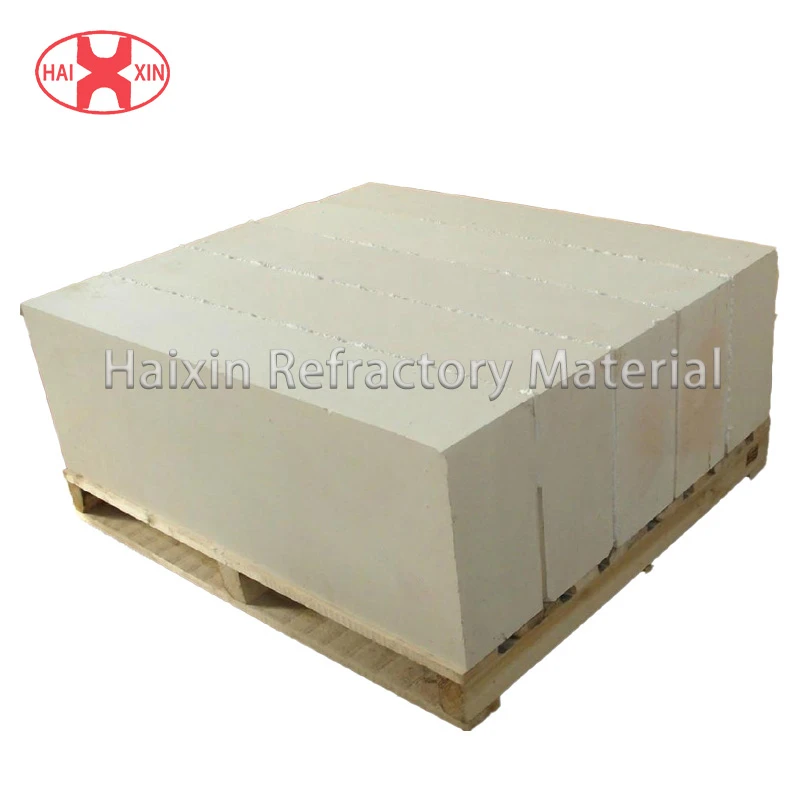
Additional Information
|
Packaging |
5-20Kg/bag, woven bag packaging. |
|
Shipping |
We offer various shipping methods, including sea freight, air freight, and express delivery, depending on the order size and destination. |
|
Terms Of Payment |
We usually accept T/T, L/C, Paypal, Credit card, etc. If you prefer other payments terms, please feel free to discuss with us. |
FAQ
We're well-known as one of the leading refractory bricks for glass building materials industry manufacturers and suppliers in China. Please feel free to buy refractory bricks for glass building materials industry at competitive price from our factory. Contact us for more details.
Sintered Mullite Bricks, Refractory Materials for Glass Kiln