

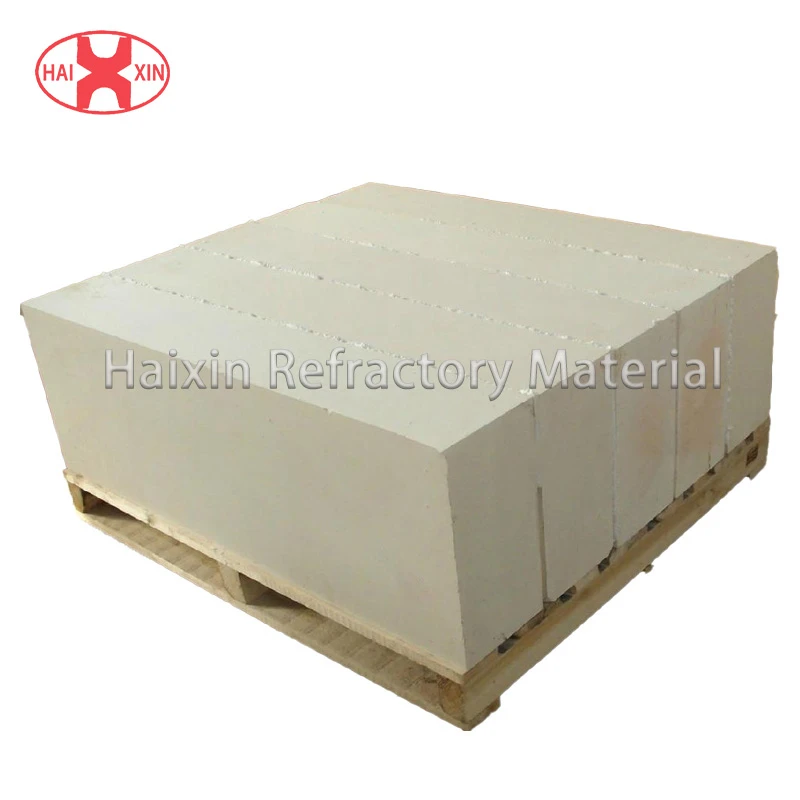


Production process of fused zirconium corundum bricks AZS33#: raw materials are imported from Australia (ILUKA) and China Alumina Group (Shangjie Aluminum Plant), etc., melted in an electric arc furnace for 2.5 hours, cast and processed.
Product features: The dense microstructure makes the brick resistant to glass liquid erosion and not easy to produce stones. It is the most widely used product in glass kilns.
Products Description
Application: Pool bottom paving bricks, pool walls, material channels, small furnace arches, etc.
Chemical composition crystal phase analysis
Aluminum: 50.16% Zirconium: 33.87% Silicon: 14.09%
Zirconia (badgestone): 32.5%
Sodium: 1.8% Iron, titanium: 0.25% Others: 0.25%
Glass phase: 21% Alumina (corundum) 46.5%

Fused zirconium corundum brick AZS33# adopts fusion-casting process
The material is melted and then cast into products. The fusion-casting method generally uses a three-phase arc furnace equipped with a voltage-regulating transformer to manufacture fused zirconium corundum bricks. The brick material is melted in the arc furnace, and then the molten liquid is poured into a high-temperature resistant mold. After cooling and annealing, it is cut into fused zirconium corundum bricks of the required shape.
Fused zirconium corundum bricks have a series of excellent properties such as large grains, dense structure, high mechanical strength, and corrosion resistance. Large-sized products can be manufactured, mainly used in glass melting furnaces. The fused-cast refractory materials used in the glass industry are zirconium corundum and pure corundum.
The batch materials for manufacturing fused zirconium corundum brick AZS33# are powdered or granular. Among them, the granular material does not produce dust flying, can be used for large-capacity electric furnace production, the material composition is accurate, and the feeding can be mechanized. The melting of the batch material is carried out in an electric arc furnace. The arc discharge concentrates huge energy in a small space to obtain a high temperature of more than 3000℃, which melts the material quickly. During casting, the furnace body is tilted to allow the molten liquid to flow out from the discharge port and into the prefabricated and assembled refractory model through the flow trough. The model can be made of quartz sand, corundum sand or graphite plate. The model is required to have a refractory performance of not less than 1700℃, good air permeability and impact resistance, no reaction with the melt, and good thermal shock resistance.
During the electrothermal melting process, the composition of the materials will change, such as SiO2 volatilizing at high temperatures, and Fe2O3 being reduced by carbon electrodes to form metallic iron.
During the cooling process of the casting, the temperature of the surface part drops sharply, while the hardening speed of the center part is slow, which generates thermal stress inside the casting and forms cracks. In order to eliminate this stress, the casting must be annealed to ensure quality.
Annealing is actually to control the hardening and cooling speed of the casting. There are two ways of annealing, one is natural annealing - putting the casting together with the mold into an incubator to cool it naturally and slowly; the other is controlled annealing - demolding the casting with hardened surface and putting it into a small tunnel kiln, and slowly cooling it according to the specified annealing curve. The quality of controlled annealed castings is better than that of natural annealing.
|
Project |
Unit |
Index |
|
|
True specific gravity |
≥ |
g/cm³ |
3.85 |
|
The velocity of the anti-glass liquid erosion in the static state (ordinary soda-lime glass 1500℃ ×36h |
≤ |
mm/24h |
1.3 |
|
Primary temperature of glass phase |
≥ |
℃ |
1400 |
|
Softening point under load |
≥ |
℃ |
1700 |
|
Coefficient of thermal expansion (1000℃) |
≤ |
% |
0.8 |
Hot Tags: azs33 fused zirconium corundum brick, China azs33 fused zirconium corundum brick manufacturers, suppliers, factory, Sintered Mullite Bricks, Refractory Materials for Glass Kiln