

Refractory Raw Materials
Shandong Haixin Refractory Material Co., Ltd. is located in Zibo, a nationally renowned refractory raw material production base. It is a large modern enterprise group integrating refractory material production and refractory furnace engineering construction.The company was founded in 1988. It mainly produces dozens of brands and hundreds of varieties of refractory products such as castable series, plastic series, prefabricated parts, refractory bricks, insulation bricks, aluminum silicate ceramic fibers, etc. After 30 years of development, our company has become a production base for wear-resistant refractory materials for industrial furnaces and kilns, and is a high-quality supplier of refractory materials for industrial furnaces and kilns with strong technical strength and supporting capabilities in China.
-
![Refractory bauxite]() Refractory bauxiteRefractory bauxite is one of the most important raw materials used in the production of refractory materials. It typically appears brownish-yellow to reddish due to its iron content. Its primary...read more
Refractory bauxiteRefractory bauxite is one of the most important raw materials used in the production of refractory materials. It typically appears brownish-yellow to reddish due to its iron content. Its primary...read more -
![Flint clay]() Flint clayCalcined refractory generally refers to high-quality refractory material obtained by calcining raw refractory ore at high temperatures. The resulting calcined refractory exhibits stable chemical...read more
Flint clayCalcined refractory generally refers to high-quality refractory material obtained by calcining raw refractory ore at high temperatures. The resulting calcined refractory exhibits stable chemical...read more -
![Sintered Mullite]() Sintered MulliteSintered mullite is a high-quality refractory material, including sintered and fused types. With high heat resistance, high strength and low thermal expansion, it is widely used in high-grade...read more
Sintered MulliteSintered mullite is a high-quality refractory material, including sintered and fused types. With high heat resistance, high strength and low thermal expansion, it is widely used in high-grade...read more -
![Chrome Fused Alumina]() Chrome Fused AluminaChrome Fused Alumina is a high-performance refractory raw material characterized by extremely high refractoriness, excellent erosion resistance, and outstanding high-temperature stability. It is...read more
Chrome Fused AluminaChrome Fused Alumina is a high-performance refractory raw material characterized by extremely high refractoriness, excellent erosion resistance, and outstanding high-temperature stability. It is...read more -
![Precision Foundry Sand、Foundry Sand、Foundry Flour]() Precision Foundry Sand、Foundry Sand、Foundry FlourPrecision Foundry Sand、Foundry Sand、Foundry Flourread more
Precision Foundry Sand、Foundry Sand、Foundry FlourPrecision Foundry Sand、Foundry Sand、Foundry Flourread more -
![Synthetic mullite]() Synthetic mulliteSynthetic mullite is a refractory material with mullite as its primary crystalline phase. It features a dense structure, appropriate bulk density, high refractoriness under load, as well as good...read more
Synthetic mulliteSynthetic mullite is a refractory material with mullite as its primary crystalline phase. It features a dense structure, appropriate bulk density, high refractoriness under load, as well as good...read more


Why Choose Us
Customized Services
Provide customized services to customers, design and produce the most suitable refractory materials according to their specific working conditions to ensure the best use effect.
Certification
The products have passed ISO9001 quality management system certification. Each batch of products meets international standards and has excellent cost performance, creating the greatest value for customers.
Sales Market
Our products are exported to the United States, Germany, Russia, India, Iran, Indonesia, Bangladesh, Kyrgyzstan and other countries and regions, providing high-quality products and services to domestic and foreign customers.
Advanced Equipment
Our company's technical center has various experimental and testing equipment for refractory raw materials and products, such as fully automatic expansion instrument, flat plate thermal conductivity instrument, load-soft tester, thermal shock test machine, reburning test furnace, etc.
The refractory raw materials produced by our company mainly include the following types:
Bauxite
Bauxite is also called bauxite or bauxite, also called burnt alumina stone, high-alumina bauxite, high-alumina aggregate, bauxite. The main component is aluminum oxide, which is a hydrated aluminum oxide containing impurities.
|
Technical indicators of calcined bauxite clinker |
|||||||
|
Label |
AL2O3 |
Fe2O3 |
TiO2 |
CaO+MgO |
K2O+Na2O |
Body density |
Water absorption |
|
HX-65 |
≥65 |
≤2.5 |
≤3.5 |
≤0.6 |
≤0.5 |
≥2.5 |
≤5 |
|
HX-70 |
≥70 |
≤2.3 |
≤3.5 |
≤0.6 |
≤0.5 |
≥2.6 |
≤4 |
|
HX-73 |
≥73 |
≤2.0 |
≤3.5 |
≤0.6 |
≤0.4 |
≥2.7 |
≤4 |
|
HX-75 |
≥75 |
≤2.0 |
≤3.5 |
≤0.6 |
≤0.4 |
≥2.8 |
≤3 |
|
HX-78 |
≥78 |
≤1.9 |
≤3.5 |
≤0.5 |
≤0.4 |
≥2.9 |
≤3 |
|
HX-80 |
≥80 |
≤1.8 |
≤3.7 |
≤0.5 |
≤0.4 |
≥3.0 |
≤3 |
|
HX-83 |
≥83 |
≤1.8 |
≤3.7 |
≤0.5 |
≤0.4 |
≥3.1 |
≤3 |
|
HX-85 |
≥85 |
≤1.7 |
≤3.7 |
≤0.5 |
≤0.4 |
≥3.15 |
≤3 |
|
HX-87 |
≥87 |
≤1.6 |
≤3.8 |
≤0.4 |
≤0.4 |
≥3.2 |
≤3 |
|
HX-88 |
≥88 |
≤1.6 |
≤3.8 |
≤0.4 |
≤0.4 |
≥3.3 |
≤3 |
|
HX-89 |
≥89 |
≤1.5 |
≤3.8 |
≤0.4 |
≤0.4 |
≥3.4 |
≤2.5 |
|
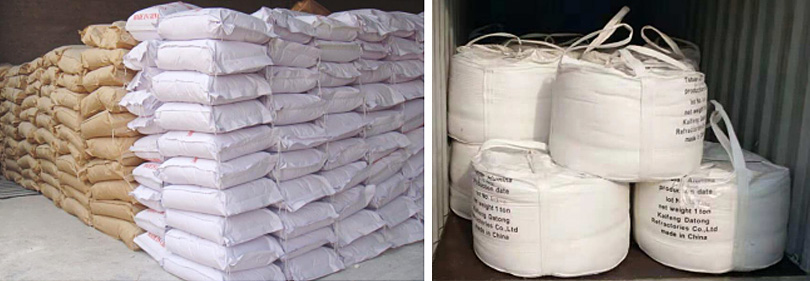
● Particle size: 0-1mm, 1-3mm, 3-5mm, 5-8mm, 8-15mm, 8-30mm, etc., can be customized according to customer needs. ● Fine powder: 80 mesh, 100 mesh, 180 mesh, 200 mesh, 220 mesh, 325 mesh ● Packaging: 25 kg laminated woven bag, 50 kg laminated woven bag, 1 ton ton bag, 1.25 ton ton bag, 1.5 ton ton bag |
|||||||
Mullite
Mullite is a high-quality refractory raw material. Currently, there are mainly sintered mullite and fused mullite. Sintered mullite is made of high-quality natural raw materials, which are selected and homogenized through multiple processes and calcined at high temperature. Sintered mullite products have stable quality and are widely used in the production of various high-temperature and low-creep products with excellent thermal shock resistance.
|
Brand/Item |
Mullite |
||||||
|
|
M75 |
M70 |
M70M |
M70L |
M60 |
M60M |
M60L |
|
AL2O3% |
≥75 |
≥70 |
≥70 |
≥70 |
≥60 |
≥60 |
≥60 |
|
TiO2% |
≤0.5 |
≤0.6 |
≤1.5 |
≤2.65 |
≤0.8 |
≤1.8 |
≤2.0 |
|
Fe2O3% |
≤0.5 |
≤0.6 |
≤1.0 |
≤1.35 |
≤0.8 |
≤1.0 |
≤1.35 |
|
K20+Na20% |
≤0.5 |
≤0.5 |
≤0.5 |
≤0.5 |
≤0.5 |
≤0.5 |
≤0.5 |
|
Bulk Density g/cm³ |
≥2.85 |
≥2.75 |
≥2.85 |
≥2.85 |
≥2.75 |
≥2.75 |
≥2.75 |
|
Apparent Porosity % |
≤3 |
≤3 |
≤3 |
≤3 |
≤3 |
≤3 |
≤3 |
|
Mineral Content % |
≥90 |
≥90 |
≥90 |
≥80 |
≥90 |
≥90 |
≥80 |
Sintered mullite can be processed into: 0-1mm/1-3mm/3-5mm/5-8mm/0-50mm Fine powder: 180#-0, 200#-0, 240#-0, 325#-0.

Advantages of Bauxite
High aluminum content: Bauxite is the primary source of aluminum metal, with a typical composition of around 40-60% aluminum oxide (Al2O3). The high aluminum content makes it an important raw material for the production of alumina and aluminum.
Hardness and abrasiveness: Bauxite is a hard and abrasive mineral, with a Mohs hardness of 1-3.5. This makes it an ideal material for use as an abrasive in various applications, including sandblasting, grinding, and polishing.
High refractoriness: Bauxite has a high melting point and is highly refractory, meaning it can withstand high temperatures without melting or deforming. This makes it a valuable material for use in the manufacture of refractory products, such as furnace linings and ceramic products.
Low conductivity: Bauxite is a poor conductor of electricity and heat, which makes it useful as an insulating material in electrical and thermal applications.
Porous structure: Bauxite typically has a porous structure, which allows it to absorb moisture and other liquids. This property makes it useful as a desiccant or drying agent in certain applications.
Exceptional Thermal Stability: Mullite can maintain stability even in extremely high temperatures, preventing structural damage due to thermal stress.
Low Thermal Expansion: Its low coefficient of thermal expansion ensures that mullite remains stable even during rapid temperature changes, reducing the risk of cracking or warping.
Outstanding Oxidation Resistance: Mullite’s resistance to oxidation makes it an ideal material for use in oxygen-rich environments, such as in metallurgy or combustion processes.
Excellent Mechanical Properties: Even at high temperatures, mullite maintains its strength and hardness, making it highly durable for demanding applications.

Application of Refractory Raw Materials
Aluminum Production
Bauxite is primarily used to produce aluminum. This process involves refining bauxite to obtain alumina, which is then smelted to produce aluminum.
Manufacturing of Refractory Materials
Bauxite is crucial in the production of refractory materials. These materials can withstand high temperatures and are essential in industrial processes.
Abrasives Production
Bauxite is also converted into alumina, which is then used to manufacture abrasive products. These abrasives are essential for cutting, grinding, and polishing various materials.
Production of Cement
Bauxite is utilized in the cement industry as a high-quality additive to improve cement quality. It acts as a flux agent to regulate the setting time of cement.
Chemical Industry Applications
Bauxite is an important raw material in the chemical industry. It is used to produce various chemicals that serve as building blocks in manufacturing.
Proppants for Hydraulic Fracturing
In the oil and gas industry, processed bauxite is used to make ceramic proppants. These proppants are essential in the hydraulic fracturing process to keep fractures open and facilitate the flow of oil or gas.
Landscaping and Road Construction
Bauxite residue, also known as red mud, is used in road construction and as a landscaping material. Its properties can improve ground stability and drainage.
Fire Retardant Products
Bauxite is essential in the production of fire retardant materials. These materials are used to enhance the fire resistance of fabrics, plastics, and building materials.
Ceramics and Porcelain Manufacture
Bauxite is used in the ceramics industry to enhance the quality of ceramic wares and porcelain. It provides strength and durability to these materials.
Application of Mullite
Ceramic Industry
Mullite is primarily used in the ceramic industry for manufacturing kiln furniture such as saggars, setters, and push plates. These tools require excellent mechanical properties and thermal shock resistance. Fused mullite, due to its superior thermal shock resistance, is an ideal raw material for high-quality kiln furniture.
Glass Industry
In the glass industry, mullite is used in ports, burner blocks, and in checker bricks. These refractories are also used in the drawing chambers as well as in the upper structure of the tanks, where glass is melted. Thermal shock resistance, high hot strength, chemical attack resistance, and creep resistance are the key properties valued by the industry.
Metallurgical Industry
Mullite is mainly used in steelmaking, such as in blast furnaces, continuous casting, and hot blast stoves. Mullite bricks feature low thermal expansion, high thermal shock resistance, and excellent chemical erosion resistance.
Aerospace Industry
Mullite is used in thermal protection materials for rocket launch platforms, capable of withstanding high-temperature gas erosion and impact. For example, the Long March 5 launch platform uses mullite-based refractories, demonstrating excellent ablation resistance and thermal insulation.
Military Sector
Mullite-based monolithic refractories are used for erosion-resistant coatings on ship decks, effectively protecting them from the heat and blast of weapon launches, while also offering good salt spray and aging resistance.
Other Industries
Mullite is also widely used in high-temperature equipment in the cement, petrochemical, and power industries, such as cement rotary kilns, and petrochemical catalytic converters.
Packaging and Shipping
FAQ
We're well-known as one of the leading refractory raw materials manufacturers and suppliers in China. Please feel free to buy refractory raw materials at competitive price from our factory. Contact us for more details.
refractory potassium phosphate, Mullite, refractory vanadium phosphate