

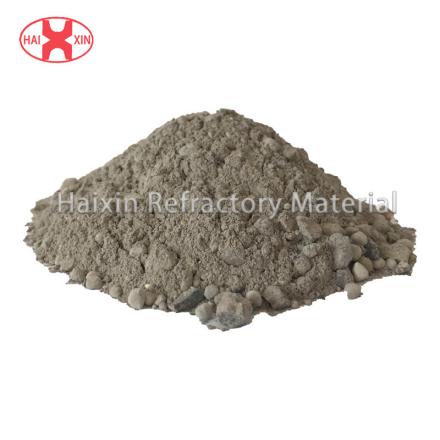
Low cement castable is a high-performance refractory material with a CaO content of 1.0% to 2.5% (the CaO content of ultra-low cement castable is 0.2% to 1.0%). With its high strength, high temperature resistance, thermal shock resistance and erosion resistance, it is widely used in the following fields:
1.Metallurgical industry
Steel smelting: used in blast furnace tapping troughs, converters, electric furnace tops, ladle linings, hot blast furnaces, etc. For example, corundum-based low-cement castables are suitable for steel refining equipment outside the furnace, while AlO-SiC-C-based castables are used for wear-resistant linings of blast furnace tapping troughs.
Non-ferrous metals: The roof and walls (parts not in contact with molten aluminum) of the aluminum smelting furnace are made of high-aluminum-based low-cement castables (such as DL-75), with an operating temperature of up to 1450°C.
2.Cement industry
Rotary kiln: Applied to high temperature parts such as the rear kiln mouth, kiln door cover, decomposition furnace, cooler, etc. The preheater and tertiary air duct of the new dry process cement kiln also use low cement castables to improve wear resistance.
Environmental protection transformation: Some cement plants use low-cement castables to enhance the corrosion resistance of equipment when co-disposing of solid waste.
3.Petrochemical and power industry
Petrochemical equipment: The inner lining of high-temperature and high-pressure equipment such as catalytic cracking reactors and petroleum cracking furnaces needs to be resistant to acid and CO corrosion.
Power boiler: The lining of boilers in thermal power plants and the refractory layer of gas turbines require thermal shock resistance and wear resistance.
4.Environmental protection
Garbage Incinerator:
Drying area (500-600℃): High-strength low-cement castable is used to resist garbage wear and thermal spalling.
Combustion zone (>1000℃): Use SiC castable (SiC content ≥40%) to resist slag corrosion.
Slag outlet: High-alumina castable to cope with low-temperature wear.
Hazardous waste treatment: The lining of the rotary kiln incinerator needs to optimize the refractory material design to reduce kiln shutdown accidents.
5.New emerging applications and technology trends
Biomass boiler: The national standard "GB/T 44906-2024" stipulates that its lining must be resistant to high temperature and corrosion by biomass fuel. Low-cement castables are preferred due to their low thermal conductivity.
Aerospace: Special corundum low-cement castables are used for high-temperature components of spacecraft, such as rocket engine insulation layers, and must meet indicators such as volume density ≥3.0g/cm³ and compressive strength >50MPa.
Technology upgrade: In 2025, the industry will focus on nano-modified materials (such as nano-silica) and AI temperature control technology to improve the early strength of castables and construction efficiency.
The core advantage of low-cement castables lies in the high-temperature stability and corrosion resistance brought by low calcium content. Its application has expanded from traditional metallurgy and building materials to new energy and environmental protection fields. Future technologies will pay more attention to environmental protection performance (such as low-carbon cementitious materials) and intelligent construction.