

Fire refractory spray coating is a kind of amorphous refractory material constructed by spraying. It has the characteristics of high construction efficiency and strong adaptability. It is widely used in the lining of thermal equipment in metallurgy, building materials, power and other industries. The following is its specific use method:
Preparation Before Construction
Make sure the surface to be sprayed is clean, dry and free of impurities. If there are cracks or uneven parts on the surface, they need to be repaired or polished to ensure flatness. The metal substrate needs to be derusted and a layer of adhesive should be applied to enhance adhesion.
Check whether the packaging of the fire refractory spray paint is intact to ensure that it is not damp or caking. Prepare the spray paint, binder and additives according to the proportions required by the instructions. Stack the spray paint in a dry environment for 24 hours in advance to make its temperature consistent with the construction environment to avoid affecting the construction performance due to temperature differences.
The spraying equipment requires the air compressor to be 0.6Mpa, the spray gun to be 0.4Mpa, and the spray gun spraying pressure to be 0.1-0.2Mpa.
Construction Process
Pour the spray paint into the mixer according to the proportion, and dry mix for 2-3 minutes to make the materials evenly mixed. Slowly add the binder until the materials are in a state where they can be held in a ball and fall apart when touched lightly. The mixing time should be controlled within 5-8 minutes.
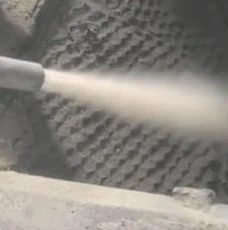
When spraying, the nozzle should be kept perpendicular to the sprayed surface and about 0.8-1.2m away, and move evenly from top to bottom in a spiral shape. Pay attention to the speed of the nozzle flow to avoid dry material and flow during the spraying process. It is better to have a small rebound, less dust, dense spraying, no interlayer, and a smooth surface. Check the spraying thickness after spraying. If it is less than the designed thickness, it should be filled in time. For complex parts such as corners, holes, flanges, etc., you can first pre-lay the cushion layer manually, and then spray to ensure a dense coating.
After spraying, use a spatula to smooth and flatten the surface in time to remove excess spray paint. Curing at room temperature for 24-48 hours, avoid rain, direct sunlight and mechanical vibration during curing. If air-hardening binders such as water glass are used, the humidity of the curing environment needs to be controlled at 60%-70%; if cement binders are used, water should be sprinkled regularly to keep them moist.
By strictly following the above steps and requirements, the construction quality of the fire refractory spray coating can be ensured, so that it can perform well under harsh working conditions such as high temperature and wear. If there are special working conditions or design requirements, it is recommended to consult professional technicians or refer to the specific product manual.