

Hot blast furnace is a thermal equipment that heats the air blown into the blast furnace from room temperature to high temperature. The hot blast furnace body consists of a heat storage chamber and a combustion chamber, as shown in the figure. Hot blast furnaces generally use blast furnace gas or a mixture of blast furnace gas and coke oven gas as fuel, and their operating temperature is 1300-1600℃. The temperature gradually decreases from the top of the furnace to the bottom.
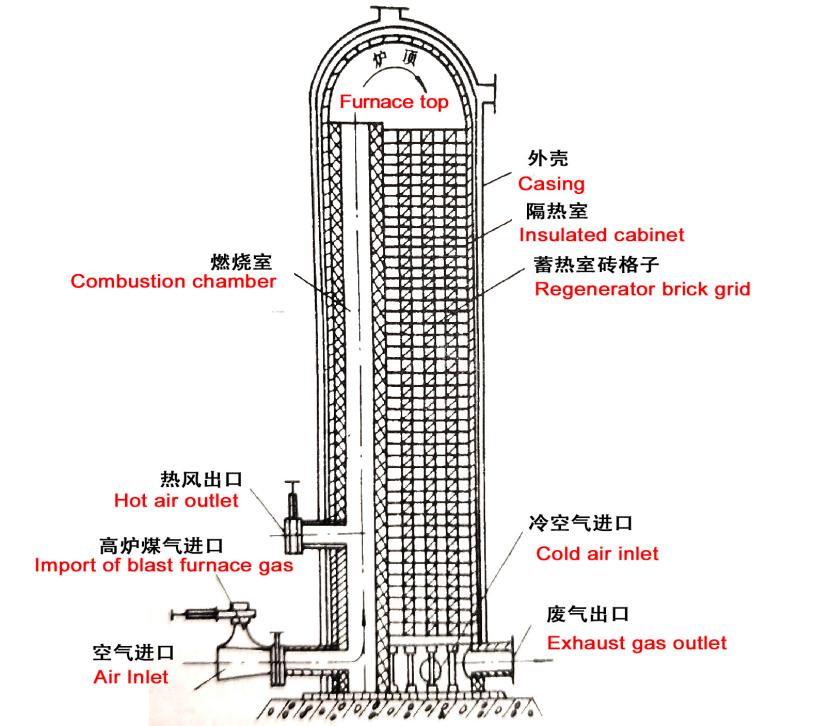
Schematic diagram of hot blast stove structure
The hot blast furnace is subjected to high temperatures of 1200-1350℃, rapid temperature changes during air heat exchange, chemical erosion from dust brought in by blast furnace gas, flushing from combustion gases, and mechanical loads. Because the hot blast furnace is a relatively high structure, the bricks in the heat storage chamber, combustion chamber, etc. shrink and deform and crack under mechanical loads and high temperatures, which affects the service life of the hot blast furnace.
The general requirements for refractory materials for hot blast furnaces are: small creep rate, large heat capacity, good high temperature strength, and good thermal shock resistance. The specific selection of refractory bricks is mainly determined by the hot blast temperature. When the wind temperature is lower than 900℃, clay bricks are generally used; when the wind temperature is 900~1100℃, high-alumina bricks, mullite bricks or sillimanite bricks are used for the furnace lining and checker bricks in the high-temperature parts; when the wind temperature is higher than 1100℃, high-alumina bricks, mullite bricks and silica bricks are generally used as furnace linings or checker bricks. When the wind temperature rises to above 1200℃, high-alumina bricks cannot meet the requirements, and high-quality silica bricks are required for the top and partition walls of the hot blast furnace and the upper part of the heat storage chamber. Due to the small heat capacity of silica bricks, low-creep mullite bricks (including low-creep sillimanite bricks and low-creep andalusite bricks) are used under the checker bricks of the silica brick layer.