


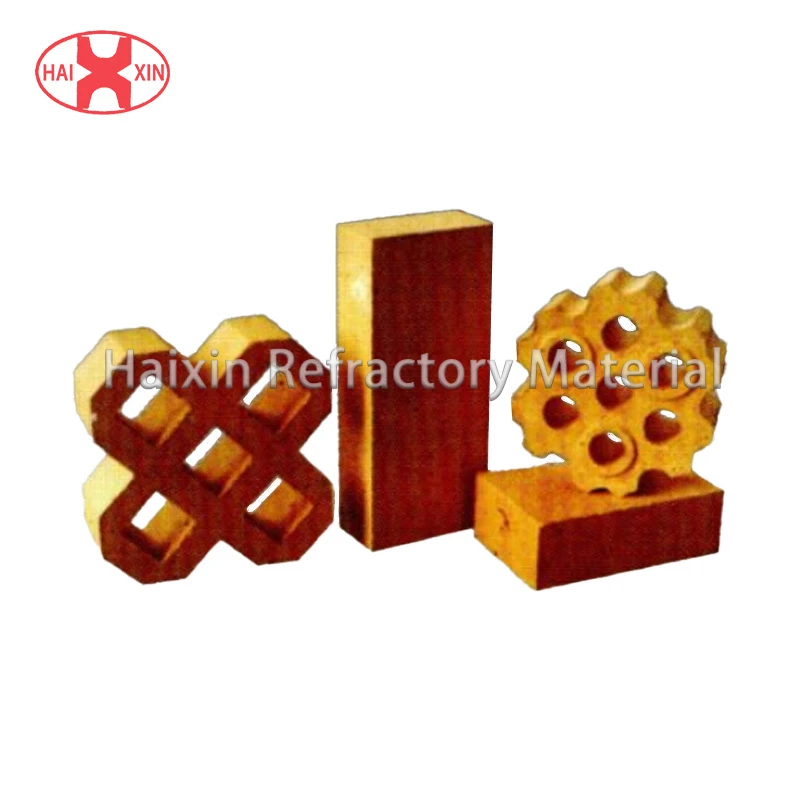
The hot blast furnace is subject to high temperatures of 1200-1350℃, the rapid temperature change during the air heat exchange process, the chemical erosion of dust brought in by blast furnace gas, the flushing effect of combustion gas, and mechanical loads. Because the hot blast furnace is a relatively high structure, the bricks in the regenerator, combustion chamber, etc. shrink and deform and crack under mechanical loads and high temperatures, affecting the service life of the hot blast furnace. The general requirements for refractory materials for hot blast furnaces are: small creep rate, large heat capacity, good high temperature strength, and good thermal shock resistance. The specific selection of refractory bricks is mainly determined by the hot blast temperature. When the wind temperature is lower than 900℃, clay bricks are generally used; when the wind temperature is 900-1100℃, high-alumina bricks, mullite bricks or sillimanite bricks are used for the furnace lining and checker bricks in the high-temperature parts; when the wind temperature is higher than 1100℃, high-alumina bricks, mullite bricks and 7. silica bricks are generally used as furnace lining or checker bricks. When the wind temperature rises to above 1200℃, high-alumina bricks cannot meet the requirements, and high-quality silica bricks are required for the top and partition walls of the hot blast furnace and the upper part of the heat storage chamber. Due to the small heat capacity of silica bricks, low-creep mullite bricks (including low-creep sillimanite bricks and low-creep O0O102-andalusite bricks) are used under the silica brick layer.
Refractory materials for hot blast stoves.
Blast furnace hot blast stoves are a type of heat storage heat exchanger, that is, thermal equipment that can heat the air blown into the blast furnace from room temperature to high temperature. In the 1950s, the working air temperature of blast furnace hot blast stoves was generally around 800℃, and exceeded 1020℃ in the 1970s. In the 1990s, it reached a maximum of 1350℃. The design air temperature of the hot blast stove of China Baoshan Iron and Steel (Group) Corporation was 1250℃. Due to the increase in air temperature, the operating conditions are more stringent, so the refractory materials used have also developed from ordinary materials to high performance and multiple varieties to meet the needs of high air temperature operation. In addition to considering the volume density and the specific heat capacity related to the heat capacity, the creep resistance of the refractory materials for hot blast stoves is still the most important indicator. Heat resistance and strength, accurate appearance and no residual expansion are all important properties. Today, purified blast furnace gas is used, so the collapse or blockage of the checker bricks due to the expansion crack (1000℃ section) is not serious.

Products Description
Refractory materials for furnace body
The furnace body of the hot blast furnace consists of a heat storage chamber and a combustion chamber. Hot blast furnaces generally use blast furnace gas or mixed gas of blast furnace and coke oven as fuel, and some use coke oven gas or heavy oil as fuel. The operating temperature is 1300-1600℃. The temperature gradually decreases from the top of the furnace. Due to the different furnace structure and operating temperature, the refractory materials used in various parts and their damage conditions are also different. The furnace body generally uses super or high-grade clay bricks, high-alumina bricks, silica bricks, mullite bricks, sillimanite bricks, andalusite bricks and some amorphous refractory materials. The damaged parts are mainly the combustion chamber, the upper part of the checkered brick masonry, the partition wall of the internal combustion furnace and the bridge of the external combustion furnace. The main reasons for the damage are high temperature, thermal stress caused by temperature changes and chemical erosion of dust. The service life of the hot blast furnace is 15-20 years, during which time the vulnerable parts need to be repaired.
Refractory materials for regenerator
When the hot air temperature is lower than 900℃, high-alumina bricks are used for the lining bricks and the upper layer of the checker brick masonry in the high-temperature parts, and high-grade clay bricks are used for the rest; when the wind temperature is 900-1100℃, high-alumina bricks, mullite bricks or sillimanite bricks are used for the lining bricks and checker bricks in the high-temperature parts, and high-alumina bricks and high-grade clay bricks are used for the rest; when the wind temperature is higher than 1100℃, low-creep high-alumina bricks, mullite bricks and silica bricks must be used for the high-temperature parts, and the insulation bricks used for the insulation layer of the furnace lining must be the same or similar to the lining bricks of the working layer. The shape, size and arrangement of the checker bricks have a great influence on the heat transfer efficiency. Honeycomb checker bricks are commonly used, and large porous or bite-type checker bricks are also used. When the dome temperature of the furnace shell at the dome or bridge of the hot blast furnace exceeds 1450℃, a large amount of NOx and other gases will be generated, which will react with condensed water to form corrosive agents, causing intergranular corrosion of the furnace shell, and cracks or cracks under the action of thermal stress. To this end, in addition to properly controlling the temperature, the insulation layer can be thickened, covered with aluminum corrugated sheet or sprayed with a layer of acid-resistant material.
Refractory materials for combustion chamber
The refractory materials used in the combustion chamber are basically the same as those used in the regenerator. They can also be built with mullite bricks or mullite bricks with silica bricks. The air and gas channels of the burner are generally built with clay bricks and high-alumina bricks. The upper part with the radiation hole (nozzle) can be built with mullite bricks or mullite corundum bricks or made of cordierite, with a service life of 2 to 4 years. This part uses high-alumina refractory castables to prefabricate parts with nozzles, which also achieves good results.
Refractory materials for other parts
Refers to hot air pipes, hot air valves, flues and chimneys, which are thermal pipelines and facilities for conveying hot air and removing exhaust gas. The 3 to 4 hot air stoves used in each blast furnace share a chimney, and the operation of each hot air stove is controlled by hot air valves and flue gates.
Refractory materials for hot air pipes
Including air supply branch pipes, main pipes and blast furnace hot air surrounding pipes. Clay insulation bricks with a thickness of 70 to 300 mm are used as the insulation layer lining, and the working layer thickness is 70 to 170 mm. Clay bricks are generally used for masonry, but high-alumina bricks or mullite bricks are used at the hot air outlet and the interface with the main air pipe. The blast furnace hot air surrounding pipe and air supply branch pipe are lined with high-alumina cement or phosphate refractory castables as a whole, with a service life of 1 to 3 years. In addition, the lining of the hot air pipe joints or bends cast on site with refractory castables has good integrity and good use effect.
Refractory materials for hot air valves
Hot air valves are heated on both sides, and also bear mechanical vibration and abrasion when the valve is raised and lowered, as well as thermal stress caused by temperature changes, so the working conditions are poor. The valve lining is built with clay bricks or high-alumina bricks, and the service life is 6 to 10 months. Since 1978, the lining of hot air valves has generally been cast and formed in the factory with alumina cement refractory castables, and is shipped after baking, and the service life can be extended to 1.2 to 2.5 years. Refractory materials for flues and chimneys Flues and chimneys are channels for exhausting exhaust gases. Hot air furnaces all adopt the bottom exhaust method. Each hot air furnace is equipped with a branch flue, and the exhaust gas is exhausted from the chimney through the main flue. The flue lining is generally built with clay bricks, and the chimney is generally poured with concrete or built with red bricks.
High-alumina cordierite bricks
High-alumina refractory products containing cordierite. The linear expansion coefficient of cordierite is small, so it has good thermal shock resistance, but low refractoriness. In order to make high-alumina cordierite products have a sufficiently high refractoriness, the content of cordierite should not be too high.
Performance Small thermal expansion coefficient, good thermal shock resistance.
Manufacturing process Use secondary high-alumina bauxite clinker particles as aggregate, add secondary high-alumina bauxite clinker fine powder, clay clinker fine powder, combined with clay fine powder and talc or other magnesium raw material fine powder in proportion. The amount of magnesium raw material fine powder added is determined so that the MgO content in the product is 2%~4%. Use sulfite pulp waste liquid as a binder. After fully mixing and evenly kneading in a wet mill according to a certain feeding order, use a friction brick press to form. After the green body is dried, it is fired at 1200~1300℃ according to a certain firing system.
In addition, there is a pre-synthesis process. The secondary high-alumina bauxite clinker, hard clay, binding clay and talc or other magnesium raw materials are accurately weighed and mixed in a certain proportion, ground into mixed fine powder, and then a suitable binder is added. After mixing, it is pressed into rough pieces. After drying, the rough pieces are calcined at 1300~1350℃ to synthesize high-alumina dongqing stone clinker. The clinker is crushed and sieved to obtain granular materials, and a part of it is ground into fine powder. The granular materials and fine powder are mixed in a certain proportion, and sulfite pulp waste liquid is used as a binder. They are mixed evenly in a wet mill and formed with a friction brick press. After the body is dried, it is fired at 1350℃.
Uses It can be used as a lining material for chlorinated pelletizing rotary kilns. It can also be used as a shelf plate, pad plate and kiln tool material for supporting bricks for ceramic firing.
|
Brand/Item |
Silica Brick |
Fire clay |
High-Alumina |
Fire ckay |
Cordierite brick |
|||||
|
HX-RG-95 |
HX-RN-42 |
HX-RN-40 |
HX-RL-65 |
HX-RL-55 |
HX-RL-48 |
HX-V7 |
HX-SCPD-2 |
|||
|
Al2O3 % |
≤1.0 |
≥42 |
≥40 |
≥65 |
≥55 |
≥48 |
≥42 |
≥55 |
||
|
Fe2O3 % |
≤1.3 |
≤1.6 |
≤1.35 |
|||||||
|
SiO2 % |
≥95 |
≤40 |
||||||||
|
MgO % |
1.7~3.0 |
|||||||||
|
Refractonriness℃ |
≥1750 |
≥1730 |
≥1790 |
≥1770 |
≥1750 |
|||||
|
Apparent Porosity % |
≤22(24) |
≤24 |
≤24 |
≤24 |
≤24 |
≤24 |
≤16 |
25(26) |
||
|
Bulk Density g/cm³ |
Density≤2.32 |
≥2.30 |
≥2.15 (2.10) |
|||||||
|
Cold crushing strength Mpa |
≥45(35) |
≥29.4 |
≥24.5 |
≥49.0 |
≥44.1 |
≥39.2 |
≥60(50) |
≥50(40) |
||
|
Refractoriness under Load K D ℃ |
≥1650 |
≥1400 |
≥1350 |
≥1500 |
≥1470 |
≥1420 |
T2≥1480 |
|||
|
Permanent Linear Change % |
1450℃×2h 0~-0.4 |
1350℃×2h 0~-0.3 |
1500℃×2h +0.1~-0.4 |
1500℃×2h +0.1~-0.4 |
1450℃×2h +0.1~-0.4 |
1450℃×4h 0~-0.2 |
||||
|
Thermal shock resistance(cycles) |
≥80 |
|||||||||
|
0.2 MPa Creep % 1 550℃×50h |
≤0.8 |
|||||||||
|
Application |
Hot air stove large wall grid, hot air stove ceramic burner |
|||||||||
Note: The values in brackets apply to checker bricks or hand-formed products.
Hot Tags: hot blast furnace refractory, China hot blast furnace refractory manufacturers, suppliers, factory, Burner Brick, High Strength Wear resistant Ceramic Castable