


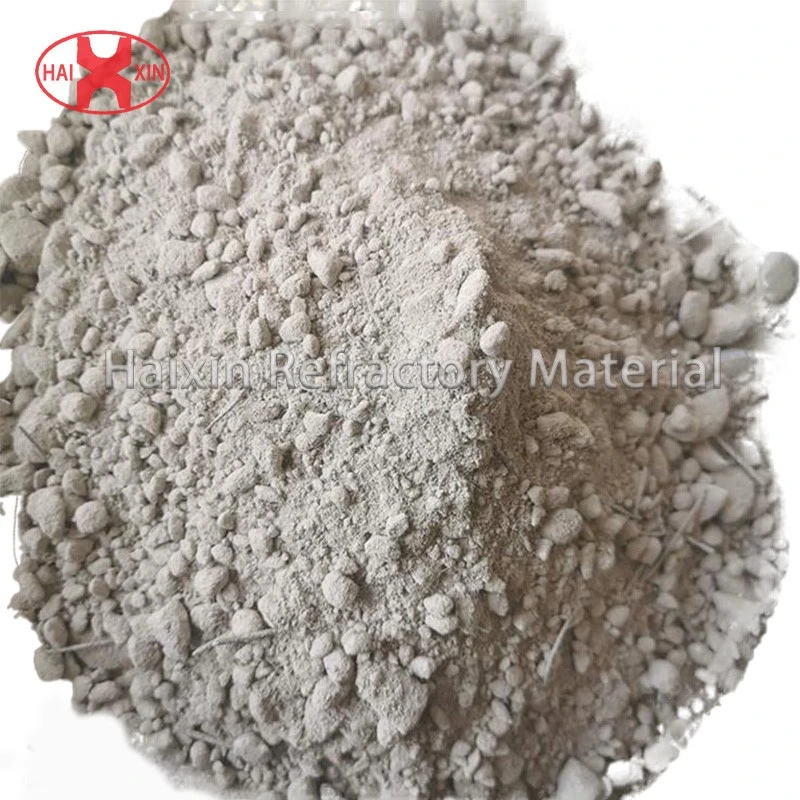
Ceramic wear-resistant casting material Flue ceramic wear-resistant material Anti-abrasive material
Ceramic wear-resistant castables now account for a considerable proportion of the energy and economic cost consumption in industrial fields such as cement plants, thermal power plants, and metallurgical mines. Taking the cement industry as an example, downtime caused by wear accounts for 50%-55% of the total downtime. Equipment wear has become one of the most important factors in determining whether a cement company can operate well. Therefore, improving the wear resistance of industry-related parts, reducing the consumption of wear-resistant materials, and extending the service life of wear-resistant materials are of great significance to improving equipment operation efficiency, reducing costs, and saving energy. As a non-metallic gelling material, ceramic wear-resistant castables not only have the characteristics of easy construction and low cost of ceramic materials, but also have the characteristics of high strength, high hardness and good wear resistance of wear-resistant materials.
Ceramic wear-resistant castables have good wear resistance and are ideal materials for vertical mills, roller presses, selectors, pipe valves and material delivery pipeline linings. On various lines (especially non-metallic mineral lines), many equipment and pipelines are subject to long-term erosion by materials or high-concentration dust-containing gases. For example, mill outlet ducts, selectors, ball mill chutes, lower hoppers, various valve cavities, gates and delivery pipelines, etc.
Products Description
Ceramic wear-resistant castables are quite strict in the processing process. Its ingredients are made of more than 20 binders and high-density silicon carbide and mullite aggregates, so there are strict requirements for on-site use. Working conditions and enterprises often encounter some problems when using anti-abrasives. Now I will give you an analysis. Common problems are as follows:
1. Welding: During the construction, the bottom frame tortoise shell mesh must be anchored and welded. The welding of the tortoise shell mesh strictly requires that the horizontal spacing of the welding points is 20mm and the vertical spacing is 10mm, so that the tortoise shell mesh and the bottom steel plate can be well welded together, so that the tortoise shell mesh will not loosen or fall off due to vibration or excessive wind speed.
2. Check the welding: After the tortoise shell mesh is welded, a preliminary inspection must be done. There must be no unqualified problems such as leaking welding or excessive spacing between welding points. If there are any problems, they must be reinforced in time to ensure the firmness of the basic skeleton.
3. Prepare for mixing: Start mixing the wear-resistant ceramic coating. Do not pour too much ceramic wear-resistant castable into the mixer at one time. Pour four bags (100 kg) each time. Pour too much will cause uneven mixing of the material and affect the material performance.
4. Start stirring; add an appropriate amount of curing agent to fully mix the wear-resistant material and the curing agent, then add an appropriate amount of glue and mix them evenly. The stirring time is preferably 10-15 minutes, until the ceramic wear-resistant castable and the glue form a wet ball with high viscosity, then it can be released from the mixer and started to be used.
5. Apply; the operator needs to be equipped with protective equipment such as labor protection gloves, masks, glasses and protective caps. If you need to wear a qualified protective belt when working at high altitude, take out an appropriate amount of wear-resistant material from the bucket (about two kilograms each time), and apply it hard on the welded tortoise shell mesh. There should be no voids or uncompacted phenomena, so that the wear-resistant ceramic coating is tightly combined with the tortoise shell mesh and the steel plate. The vertical surface and the top need to be formed at one time, and cannot be applied in layers to prevent the occurrence of layering.
6. Check; the applied wear-resistant ceramic coating should not have bulging or collapse. If it is found, reapply it in time until the ceramic wear-resistant castable is tightly combined with the steel plate before use.
7. Maintenance: Ceramic wear-resistant castables must reach the required strength after the maintenance period before they can be used normally. This is generally 48 hours in summer and 72 hours in winter.
Hot Tags: high strength wear-resistant ceramic castable, China high strength wear-resistant ceramic castable manufacturers, suppliers, factory, High Strength Wear resistant Ceramic Castable, Burner Brick