

1. The role of anchor nails
Anchor nails (also known as grab nails, anchors) are the core components of the tortoise shell mesh heat insulation and wear-resistant lining system, and they mainly play the following roles:
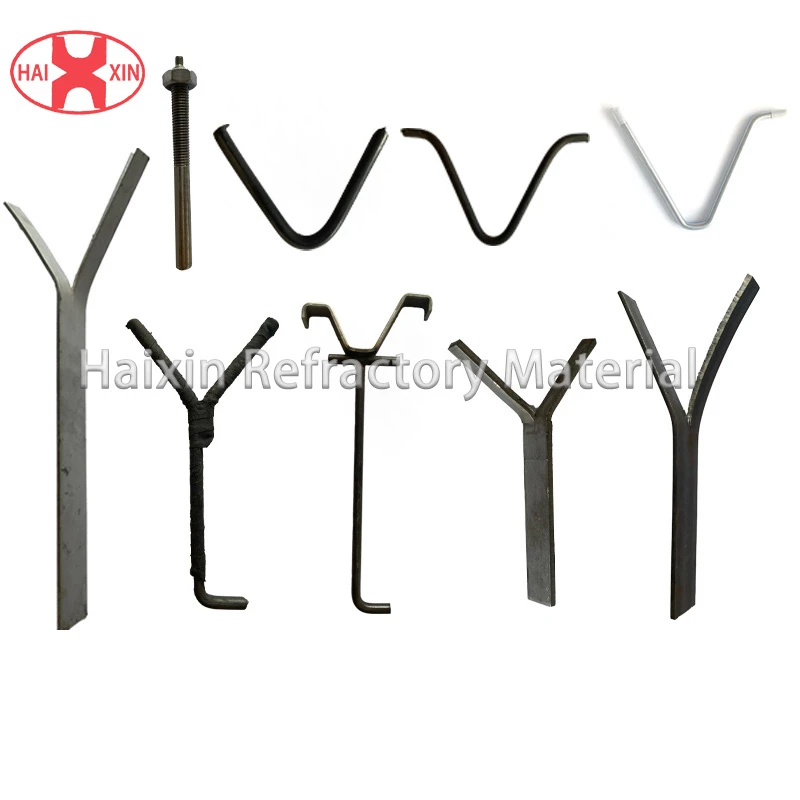
1. Fix the tortoise shell mesh
As the supporting skeleton of the tortoise shell mesh, it is welded to the inner wall of the equipment to ensure that the tortoise shell mesh is firmly attached to the substrate.
2. Enhance the bonding strength of the lining
Through mechanical anchoring, the castable or sprayed lining material is tightly bonded to the wall of the equipment to prevent it from falling off.
3. Resist thermal stress and mechanical shock
Relieve the thermal expansion stress caused by sudden temperature changes and reduce the risk of lining cracking.
Improve the vibration and scour resistance of the lining layer.
4. Extend the life of the lining
Disperse stress to prevent the lining layer from failing due to excessive local wear.
2. Main types of anchor nails
Based on the structure, material and application scenarios, anchor nails can be divided into the following categories:
1. Classification by structure
(1) Y-type anchor nail
Features: bifurcated design, strong gripping force, excellent pull-out resistance
Applicable scenarios: suitable for high wear and high stress areas (such as cyclone separators, boilers). High temperature equipment in the petrochemical and power industries.
(2) V-type anchor nail
Features: simple structure, easy welding, low cost
Applicable scenarios: suitable for general wear-resistant linings. Linings of equipment in the metallurgical and cement industries.
(3) L-type anchor nail
Features: right-angle bending design, used in complex parts such as equipment corners and pipes to enhance local fixation.
Applicable scenarios: flues, elbows, special-shaped structures.
(4) Threaded anchor nail
Features: with threaded connection, removable, easy to repair or replace the lining.
Applicable scenarios: equipment that requires frequent maintenance (such as reactors).
2. From the material point of view, common anchor nails include carbon steel anchor nails (temperature resistance below 500℃), 304 stainless steel anchor nails (temperature resistance below 800℃), 310S stainless steel anchor nails (temperature resistance below 1100℃) and special heat-resistant alloy anchor nails (temperature resistance above 1200℃). When selecting, it is necessary to comprehensively consider factors such as working temperature, corrosive environment and wear intensity. At the same time, the welding quality and layout spacing must be strictly controlled, usually within the range of 150-300mm, and high stress areas need to be appropriately increased. These anchor nails are widely used in various high-temperature wear-resistant equipment in petrochemical, electric power, metallurgical and other industries, and are an important guarantee for ensuring the long-term stable operation of the lining system.