

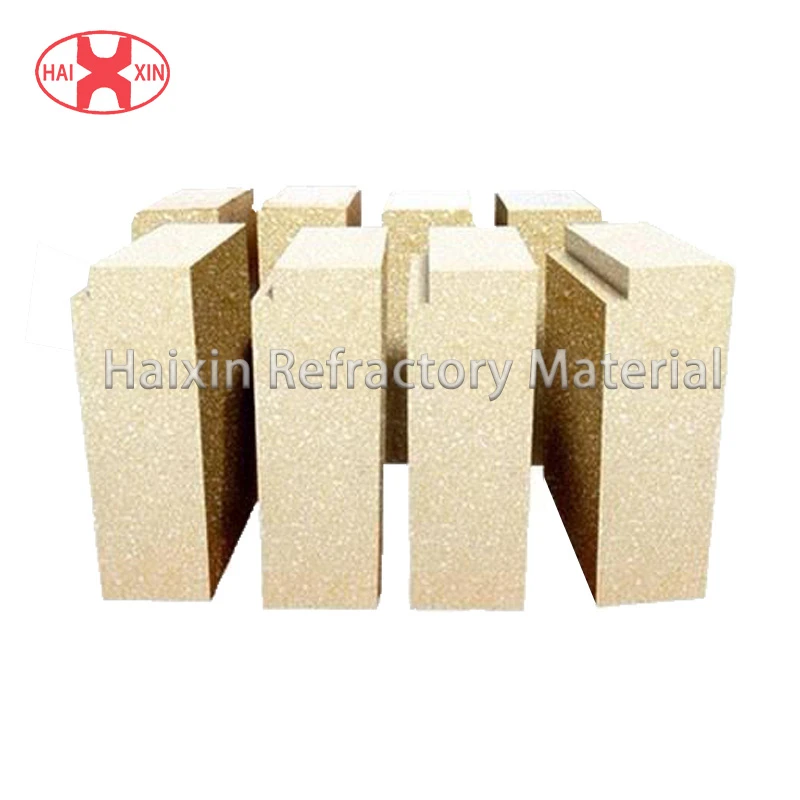
Clay furnace bricks are Al2O2-SiO2 refractory materials made of clay (kaolin, refractory clay) as the main raw material, through molding and sintering. The Al2O2 content is usually 30%~48%, which belongs to the basic category of traditional refractory materials. In glass kilns, although its high temperature resistance is not as good as that of fused zirconium corundum bricks (AZS) or silica bricks, it still has certain application value in specific parts.
1. Applicable scenarios of clay furnace bricks in glass kilns:
(1) Middle and lower part of the regenerator
Working conditions: temperature 800~1200℃, contact with alkaline volatiles (Na₂CO₃, K₂SO₄, etc.).
Advantages: low cost (about 1/3 of magnesia-chrome bricks), medium resistance to alkaline dust erosion.
Application form: grid support layer, flue lining.
(2) Kiln foundation and insulation layer
Function: as insulation bricks (light clay bricks) or structural support layer, avoid direct contact with high-temperature flames.
Design points: need to be matched with high-alumina bricks or aluminum silicate fiberboard to enhance insulation.
(3) Small glass kiln or intermittent kiln
Scenario: laboratory kiln, handicraft glass kiln and other low-temperature short-cycle working conditions.
Note: The erosion needs to be checked regularly, and the service life is usually only 1~2 years.
2. Optimization strategy for the use of clay bricks in glass kilns:
(1) Composite masonry design
Example: The lower part of the heat storage chamber adopts a stepped structure of clay bricks + upper magnesia-chrome bricks, taking into account both cost and performance.
Joint treatment: Use high-alumina fire clay (Al₂O₃>65%) to fill and reduce the penetration of alkaline substances.
(2) Surface modification technology
Siliconization treatment: Impregnate silica sol on the surface of clay bricks to form a SiO₂ protective layer to delay alkali corrosion.
Spray coating: Plasma spraying Al₂O₃ or SiC coating can improve surface hardness and impermeability.
(3) Maintenance and monitoring
Regular inspection: Use an endoscope to observe the erosion depth of the clay bricks in the heat storage chamber. When the erosion rate is >30%, partial replacement is required.
Temperature control: Ensure that the temperature of the clay brick use area is <1200℃ to avoid overheating and sintering shrinkage.