

In the construction of refractory castables, the design of coating or wrapping plastic on the surface of metal anchors is mainly based on the following key reasons. These measures significantly improve the stability and durability of the refractory structure:
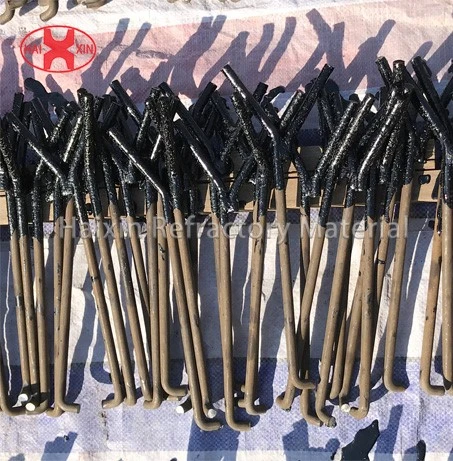
1.Buffering thermal expansion differences
The thermal expansion coefficients of metals and refractory castables are significantly different. At high temperatures, metals expand much more than refractory materials, resulting in huge stress on the contact surface. Plastics, as a flexible intermediate layer, can absorb expansion deformation and avoid stress concentration-induced castable cracking or anchor deformation.
2.Prevent local overheating caused by heat conduction
Metal is an excellent conductor of heat. Direct exposure to high temperatures may form a "thermal bridge", which accelerates the transfer of heat to external structures, causing local overheating or even damage. Plastics can act as an insulation layer to reduce the rate of heat conduction and protect surrounding non-high temperature resistant parts.
3.Enhance the bonding between anchors and castables
Smooth metal surfaces may lead to insufficient adhesion of castables. Plastics can improve the bonding strength between the two by increasing surface roughness or chemical reaction, thus preventing castables from falling off.
4.Protect metals from oxidation and corrosion
In high temperature environment, metal is easy to oxidize and rust. Plastics isolate oxygen and chemical media, extending their life.
5. Adapt to deformation during construction and curing
The castable may shrink when solidifying, but the anchor position needs to remain stable. The plastic provides a slight elasticity to allow small displacement adjustments and avoid cracking caused by shrinkage stress.
6.High temperature ablation forms a buffer space
Some plastics burn away during the initial high-temperature heating, leaving a preset gap. This space provides a "relief zone" for metal expansion, preventing the expansion force from acting directly on the refractory layer.
The surface of the metal anchor should usually be coated with asphalt or paraffin, or wrapped with electrical plastic tape, with a thickness of 1~2mm. Since the thermal expansion coefficient of the refractory castable is very different from its thermal expansion coefficient, in order to prevent it from having a large expansion during the heating process and causing excessive tensile stress in the refractory castable, asphalt is applied to its surface. These coatings are burned off during the heating process, leaving it with free expansion space.
In summary, this process ensures the long-term stability of the refractory structure under high temperature, corrosion and mechanical stress through multi-dimensional protection, which is an indispensable detail treatment in the design of industrial kilns.