

Zircon bricks are refractory products made of zircon as the main raw material. Zircon is the only compound in the ZrO2-SiO2 system, with the chemical formula ZrSiO4 and its theoretical chemical composition of ZrO267.2%, SiO232.8%. Zircon bricks have excellent properties such as high temperature resistance, good thermal shock resistance, resistance to slag erosion and resistance to glass liquid erosion. They work stably in an oxidizing atmosphere and do not react chemically with molten metal.
Zircon bricks can be used as large bricks for the bottom of glass tank kilns, upper structural materials, linings for steel ladle, and water nozzles for continuous casting, etc.
This article will introduce the zircon refractory series - sintered zircon bricks.
Sintered zircon bricks are refractory products made from natural zircon sand (ZrSiO4) as the main raw material, which are crushed, formed, and sintered at high temperature (usually 1600-1800℃). They are an important branch of zircon refractory materials.
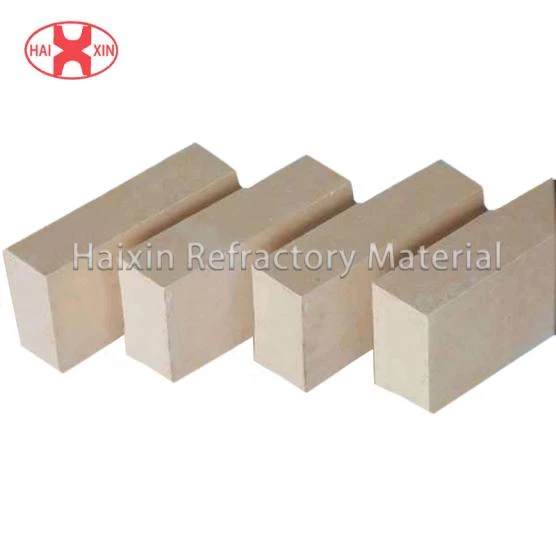
Main performance characteristics
✅ High refractoriness (up to 1750-1850℃)
✅ Excellent thermal shock resistance (due to ZrSiO4's low thermal expansion coefficient)
✅ Resistant to chemical corrosion (resistant to alkaline slag and glass liquid corrosion)
✅ High mechanical strength (sintering densification improves compressive strength)
❌Disadvantages: Compared with fused zircon bricks, the porosity is slightly higher and the corrosion resistance is slightly weaker.
Typical Applications
Glass industry: glass furnace regenerator, flow tunnel lining
Metallurgical industry: refractory materials for ladle and tundish (resistance to alkaline slag corrosion)
Ceramic industry: high temperature kiln furniture, push plate bricks
Chemical industry: refractory linings for corrosive environments
Sintered zircon bricks have outstanding performance in glass, metallurgy and other fields due to their excellent corrosion resistance and high temperature stability, but they are expensive and have weak alkali resistance. Reasonable selection can give full play to their performance advantages. In the future, material optimization will further expand the application space and provide reliable protection for high temperature industries.