

The installation quality of aluminum silicate ceramic fiber module directly affects their thermal insulation performance and service life, and requires strict control from several aspects including preliminary preparation, installation process, and detail processing.
1. Preliminary Preparation
Material and environmental inspection
Confirm that the aluminum silicate ceramic fiber module is not damaged, damp, or has exposed fibers, check that the module dimensions are consistent with the design drawings, and check whether the anchors meet the design requirements.
Installation base surface treatment
The steel plate of the furnace shell needs to be derusted and degreased to ensure that there are no impurities. The surface flatness of the furnace shell should be tested to prevent uneven force after the module is installed, which may cause tearing. The module needs to be tested before the anchor is welded to ensure the welding position is accurate.
2.Installation Process
Module installation order
From bottom to top, from one end to the other, the bottom modules need to be supported by brackets to prevent them from sliding down; expansion space needs to be reserved when installing the top modules. The joints of adjacent modules need to be staggered by ≥150mm to avoid the formation of direct thermal bridges.
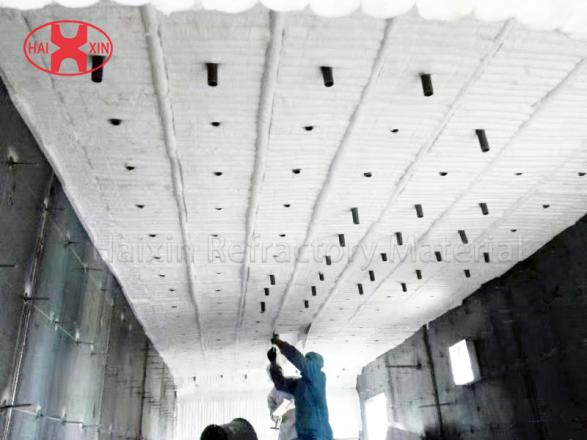
Module fixation and rebound control
Remove the strapping tape after the module is placed in the installation position to avoid premature rebound that causes positioning difficulties. When installing the folding module, keep 10%~15% pre-compression, and adjust the bolts or pressure plates through the anchors to ensure a tight fit after rebound. The bolts or pressure plates must be tightened evenly to avoid partial over-tightening that crushes the module or over-loosening that causes it to fall off.
Seam treatment
When the gap between modules is greater than 5mm, it is necessary to fill and compact it with ceramic fiber blanket or refractory fiber wool to ensure that there is no air leakage; in high temperature areas (greater than 1000℃), plastic or castable materials can be used for sealing. After installation, use a ruler to check the surface flatness.
3.Details
Special parts and risk prevention and control
A ≥50mm expansion gap should be reserved around the pipe, which should be filled with ceramic fiber rope around the pipe and sealed with high-temperature resistant sealant on the outer layer to prevent hot air leakage. A special ceramic fiber cutting tool should be used for cutting, and the incision should be smooth; after cutting, the edge of the module should be coated with high-temperature adhesive to prevent loosening. An expansion joint (width 20~30mm) should be set every 3~5m, and the ceramic fiber blanket should be filled and compacted in the joint. The modules on both sides of the joint should be fixed independently with anchors to avoid structural damage caused by expansion and extrusion. L-shaped module transition or reserved slope expansion joints should be used to prevent the top module from extruding the side wall module due to thermal expansion and contraction. In high temperature environment, the surface of the module can be sprayed with an inorganic binder aqueous solution to reduce fiber shedding and improve surface strength. After installation, a high-temperature resistant coating with a thickness of 2~3mm is applied to the surface of the module to effectively seal the fiber pores and prevent scouring and erosion.
The aluminum silicate ceramic fiber module we produce strictly control the quality of raw materials and adopt advanced production technology to ensure that each module has stable and excellent performance. In terms of installation and supporting services, we have a professional technical team that can provide customers with one-stop services from early solution design, on-site installation guidance to later maintenance.