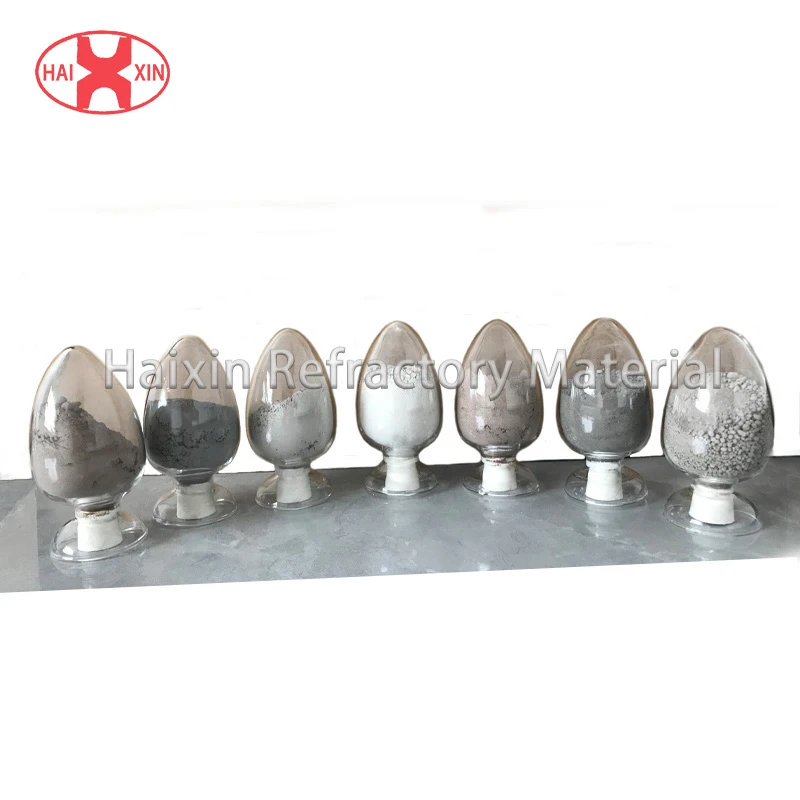
Unshaped Refractory Materials refer to materials that can be directly formed into refractory structures through construction (such as pouring, ramming, spraying, etc.) without pre-forming and sintering. Compared with shaped refractories (such as refractory bricks), they have the advantages of flexible construction, good seamlessness, and adaptability to complex shapes. They are widely used in metallurgy, building materials, chemicals, electricity and other industries.
Main types and characteristics
1. Refractory Castables
Refractory castables are composed of refractory aggregate, fine powder, binder and admixture. After adding water and stirring, they are fluid and can be cast into shape.
Features: easy construction, can form a dense structure, and are suitable for complex shapes.
Binding method: commonly used aluminate cement, phosphate or sol bonding.
Application: blast furnace, heating furnace, boiler lining, electric furnace top, etc.
2. Refractory Plastics
Refractory plastics use plastic clay as a binder. After mixing with refractory aggregate, they are in a paste state. They are formed by ramming or extrusion during construction.
Features: strong plasticity at room temperature, high strength after high-temperature sintering, and good thermal shock resistance.
Application: electric furnace top, heating furnace wall, hot air duct, etc.
3. Refractory Gunning Materials
The dry/wet mixture is sprayed onto the surface of the substrate by a sprayer to quickly form a refractory layer.
Features: fast construction speed, suitable for repair and large-area construction.
Classification: wet spraying (mixed with water) and dry spraying (mixed with water).
Application: converter, ladle, flue, metallurgical furnace lining, etc.
4. Refractory Ramming Materials
Compacted by manual or mechanical ramming, usually used in high wear-resistant or high erosion-resistant parts.
Features: high density, strong slag resistance, but high labor intensity in construction.
Application: induction furnace bottom, iron tapping ditch, blast furnace tapping hole, etc.
5. Refractory Mortars
Joint material used for masonry refractory bricks, composed of fine powder and binder.
Classification: sintered type (sintered and bonded at high temperature), chemically bonded (phosphate, silicate), hydraulic type (cement bonded).
Application: Brick joint filling in blast furnaces, hot blast furnaces, coke ovens, etc.
Amorphous refractory materials have become indispensable materials for high-temperature industries due to their flexibility and economy, and will further develop in the direction of high performance, environmental protection and intelligence in the future.