

The arrangement and spacing of anchors depend on the shape of the furnace shell or components, the material and thickness of the lining, the operating temperature and operating conditions (continuous and intermittent operation), and the size of the thermal and mechanical stresses borne by the lining. The arrangement of anchors must take into account both sufficient support strength and the fact that it will not cause cracks of longer length in the refractory during thermal expansion and contraction. For example, the arrangement of metal anchors as shown in the figure below has a better effect. The spacing of anchors is generally 3 times the thickness of the lining. The spacing of anchors can be smaller than normal in places where the load and stress are concentrated. For metal anchors, the minimum spacing of anchors used for thin and light linings is 150mm, while the maximum spacing of anchors for heavy linings is about 300mm. For ceramic anchors, the center distance between anchors is 250-350mm. The spacing of anchors on the top of the furnace should be smaller, while the spacing of anchors on the furnace wall (wall) can be larger.
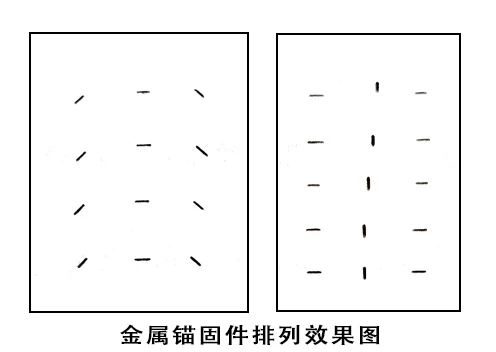
Metal anchor arrangement effect diagram
The length of the metal anchor is about 1/2 to 2/3 of the thickness of the lining, and cannot be equal to the thickness of the lining to prevent the metal from melting and oxidation due to high temperature. The length of the ceramic anchor should be equal to the thickness of the lining and can extend to the working surface to reduce the peeling of the entire lining. The metal anchor can be directly welded or riveted to the furnace shell, or fixed to the furnace shell in the form of bolts and nuts. The ceramic anchor is fixed to the furnace shell with a connector with a metal clamp, or fixed to the steel structure beam with a movable metal hook. This metal connecting the ceramic anchor to the furnace shell is a movable connector that allows the connected ceramic anchor to produce a slight displacement with the thermal expansion of the lining.