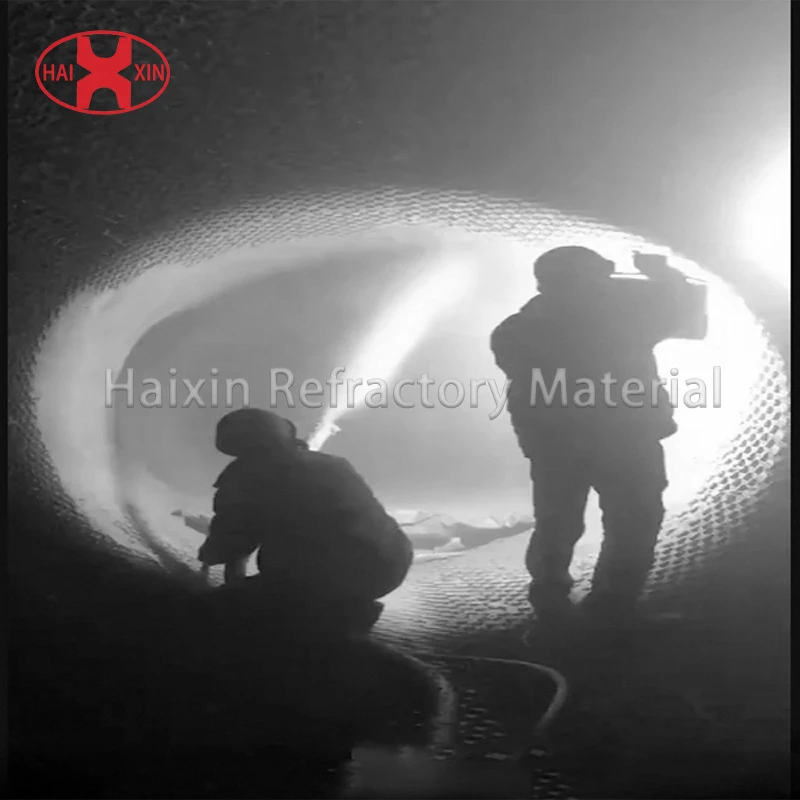
There are several construction methods for refractory spray coatings, such as wet spraying, semi-dry spraying, and flame spraying.
Wet spraying is a method of mixing refractory aggregates, binders, additives, and water to form a slurry of a certain consistency, and then spraying the slurry onto the spraying surface with compressed air through a spraying machine. It is characterized by simple operation, high adhesion rate, and rapid sintering. However, due to the high water content and fine particles, the shrinkage is also large. At the same time, due to the thin spraying layer, the durability is not very good.
Semi-dry spraying is a method of mixing a mixture of refractory aggregates, binders, additives, etc. with water through the water ring hole at the tail end of the spray gun, and spraying it onto the spraying surface by compressed air. The amount of water can be adjusted at any time according to the spraying situation, generally fluctuating between 10 and 20%, which is much lower than the water consumption of wet spraying. Therefore, the volume density of the gunning layer is large, the shrinkage is small, and a thicker gunning layer can be obtained with better durability, but the rebound amount is slightly higher than the wet method. This gunning method is more commonly used.
Flame gunning is a repair method that uses compressed oxygen to transport a mixture of refractory aggregates, flux or heating agent to the nozzle, mixes and burns with high calorific value fuel, instantly heats the surface of the refractory aggregate particles to a molten or semi-molten state, and then sprays and adheres to the furnace lining. The gunning layer obtained by this construction method has a dense structure, high strength, strong erosion resistance and anti-scouring ability, and is solid and durable. However, the flame gunning device is expensive, the technology is complex, and the construction energy consumption is also high.