

Advantages of phosphate-bonded high-alumina bricks for cement kilns over ordinary high-alumina bricks
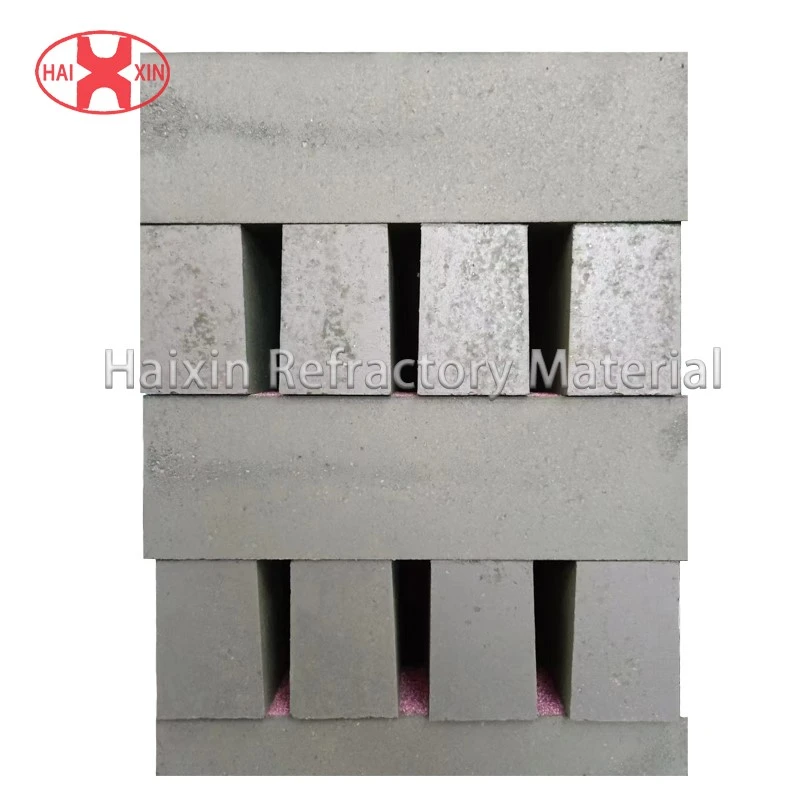
Phosphate-bonded high-alumina bricks for cement kilns are high-alumina refractory products made of high-alumina bauxite clinker as aggregate and fine powder, phosphoric acid or aluminum phosphate as binder, semi-dry pressing and heat treatment at 400-600℃. They can be used in the transition zone, firing zone, cooling zone, cooler and working layer of cement kiln.
The building materials industry standard (JC350-1993) divides phosphate-bonded high-alumina bricks for cement kilns into two types according to the binder:
(1) Phosphate-bonded high-alumina bricks (abbreviated as phosphate bricks) have a binder of 42.5%-50% phosphoric acid solution. The code is P, and the lock-seam brick is PC.
(2) Aluminum phosphate-bonded high-alumina wear-resistant bricks (abbreviated as wear-resistant bricks) have a binder of aluminum phosphate solution made of industrial phosphoric acid and industrial aluminum hydroxide, with a molar ratio of Al₂O₃:P₂O₅=1:3.2. The code is PA.
Performance characteristics
High refractoriness: high Al₂O₃ content, refractoriness is usually ≥1770℃, high load softening temperature (about 1500-1600℃).
Excellent thermal shock resistance: phosphates combine to form a microcrack structure, which can buffer thermal stress, and the thermal shock resistance is better than ordinary high-alumina bricks.
High mechanical strength: the compressive strength at room temperature can reach 50-100MPa, and the strength retention rate is good at high temperature.
Strong resistance to slag erosion: low porosity (15-20%) and dense structure can resist the penetration of slag and alkali metal vapor.
Abrasion resistance: suitable for areas with severe air flow scouring or mechanical friction.
Production process
Raw material processing: high alumina is crushed and screened to the appropriate particle size (three-level ratio of coarse, medium and fine).
Mixing: fully mix with phosphate solution to form plastic mud.
Molding: high pressure molding (such as friction brick press or hydraulic press) to ensure the compactness of the blank.
Drying: low temperature drying (100-200℃) to avoid premature decomposition of phosphate.
Firing: high temperature firing (usually 1300-1450℃) to form a stable phosphate binding phase.
Advantages compared to ordinary high alumina bricks
|
Characteristics |
Phosphate high alumina brick |
Ordinary high alumina brick (sintered) |
|
Joining method |
Chemical bonding (phosphate) |
Ceramic bonding (sintered) |
|
Thermal shock resistance |
Better (microcrack buffer) |
Worse (higher brittleness) |
|
High temperature strength |
Higher (chemical bond strengthening) |
Lower (depends on the degree of sintering) |
|
Slag resistance |
More compact, strong anti-permeability |
Higher porosity, easy to be corroded by slag |
|
Production process |
Lower firing temperature, less energy consumption |
High temperature firing required (above 1500℃) |