

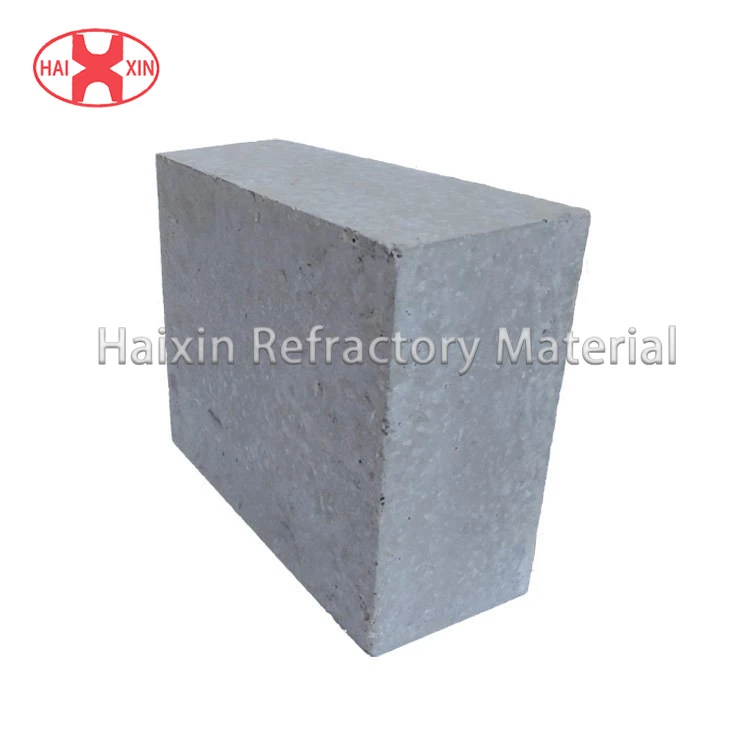


Phosphate-bonded high-alumina wear-resistant bricks P, PA, TP-1
Phosphate-bonded high-alumina bricks are chemically bonded refractory products made by using phosphoric acid solution or aluminum phosphate solution (aluminum dihydrogen phosphate, PA-80 glue, etc.) as a binder, using bauxite clinker as aggregate, machine pressing, and treating at a temperature of 500-600℃.
Phosphate-bonded high-alumina bricks are referred to as phosphate bricks; while aluminum phosphate-bonded high-alumina bricks are referred to as wear-resistant bricks. The latter has higher compressive strength.

Products Description
Traditional phosphate-bonded high-alumina bricks have two obvious shortcomings. One is that the load softening temperature is low, about 1300℃; the other is that the reburning line shrinks greatly, which affects its use effect and use field. In order to solve this problem, Shengyang Refractory Materials adds three stones to the production materials as an important measure. As mentioned above, three stones are irreversibly transformed into mullite and SiO2 at high temperatures, accompanied by volume expansion. Using this characteristic, the load softening temperature of the product is increased, the shrinkage at high temperatures is reduced, and the thermal shock resistance is improved.
In recent years, high-load softening unfired high-alumina bricks with a load softening temperature of not less than 1550℃ have been developed, becoming a new generation of phosphate-bonded high-alumina bricks. The key to its production is to use three-stone minerals more reasonably, such as using composite materials or adjusting the particle size and dosage.
Phosphate refractory bricks are divided into phosphate bricks and phosphate wear-resistant bricks. The difference is that phosphate bricks use phosphoric acid as a binder, while phosphate wear-resistant bricks use aluminum dihydrogen phosphate as a binder. They are generally divided into low-grade phosphate bricks and high-temperature phosphate bricks. There is not much difference between these two bricks, because phosphate bricks have good wear resistance. High-grade phosphate bricks are high-load soft phosphate bricks. Since phosphate bricks are bound by phosphoric acid, the load softness is generally low. Above 1300~1450℃.
Phosphate-bonded high-alumina bricks and phosphate-bonded high-alumina wear-resistant bricks are made of dense high-alumina bauxite clinker as aggregate, phosphoric acid and phosphate as binders, respectively, through high-pressure molding and medium-temperature heat treatment. The products have excellent thermal shock stability, wear resistance and chemical corrosion resistance, and are widely used in the preheating zone, decomposition zone and kiln door cover of rotary kilns, the lining of coolers, etc.
Special phosphate-bonded high-alumina bricks are based on phosphate-bonded high-alumina bricks, and additives are added to improve the high-temperature properties of the products such as load softening temperature. The products are widely used in transition zones and firing zones of small and medium-sized dry-process kilns and wet-process kilns, and can also be used in side zones, kiln door covers, coolers, etc. of large dry-process kilns.
1. It has good resistance to chemical erosion, and its alkali resistance is far superior to clay bricks and high-alumina bricks.
2. It has high strength and good wear resistance.
3. It has good thermal shock resistance.
|
Indicators/project |
P |
PA |
TP-1 |
|
Al2O3 % ≥ |
75 |
77 |
70 |
|
Apparent porosity% ≤ |
19 |
||
|
Bulk density g/cm3 ≥ |
2.65 |
2.70 |
|
|
0.2MPa Load softening start temperature ℃≥ |
1350 |
1300 |
1500 |
|
Normal temperature compressive strength MPa ≥ |
60 |
65 |
65 |
Hot Tags: phosphate brick tp-1, China phosphate brick tp-1 manufacturers, suppliers, factory, refractory bricks for fishmonger, refractory bricks for tourism industry, refractory bricks for hardware store, refractory bricks for cosmetic industry, refractory bricks for aquarium, refractory bricks for furniture industry