

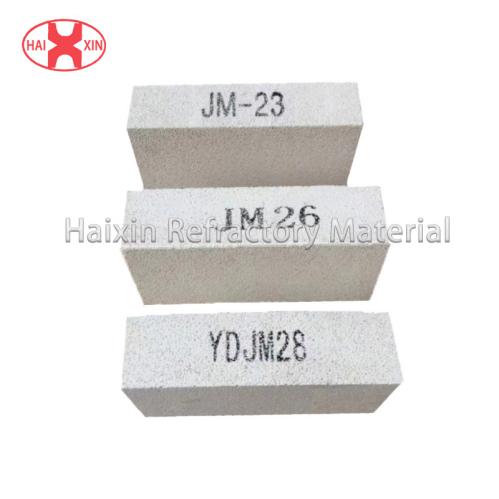
In modern industrial high-temperature equipment and furnaces, the performance of refractory materials directly affects energy consumption, safety and production efficiency. Lightweight mullite bricks, with their unique material structure, have successfully achieved an excellent balance between efficient thermal insulation and high-temperature stability, becoming the preferred material for many industries.

Analysis of core advantages
High efficiency insulation, energy saving and consumption reduction
Lightweight mullite bricks are rich in uniform microporous structures, making their thermal conductivity significantly lower than that of traditional refractory bricks. This feature effectively blocks heat transfer, reduces heat loss from the kiln shell, and can reduce energy consumption by 15%-30%. It is especially suitable for petrochemical, ceramic and glass melting furnaces that have strict temperature control requirements.
High temperature stability, long-lasting durability
With mullite as the main crystal phase, the material has a load softening temperature of more than 1600℃ and excellent thermal shock resistance. Even under rapid cooling and heating conditions, it can still maintain structural integrity, avoid cracking or peeling, and extend the life of the equipment.
Lightweight design to reduce load
The density is only 1/2-2/3 of that of traditional refractory bricks, which greatly reduces the load-bearing capacity of the kiln steel structure and is particularly suitable for renovation projects or weight-sensitive application scenarios.
Application Areas
From steel metallurgy, cement rotary kiln to chemical cracking furnace, lightweight mullite bricks perform excellently in high-temperature insulation layers, kiln linings, etc. Its environmental protection characteristics (low heat storage, no harmful volatilization) are more in line with the trend of green manufacturing.
Lightweight mullite bricks have solved the contradiction between "insulation" and "strength" in high-temperature environments through material science and process innovation, providing a reliable solution for industrial energy conservation and carbon reduction. In the future, with the advancement of microporous structure optimization technology, its performance boundaries will be further expanded.