

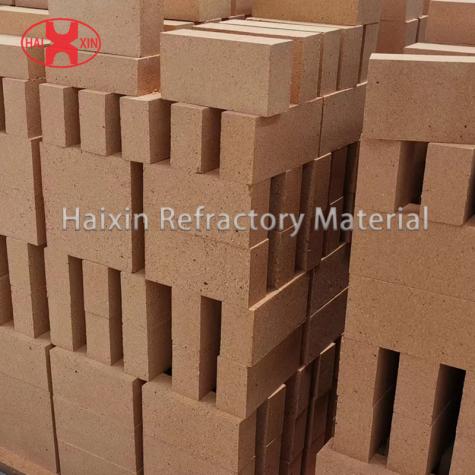
Clay refractory bricks are a traditional refractory material made of refractory clay as the main raw material, which is formed, dried and fired at high temperature. Due to its excellent high temperature resistance, good thermal shock resistance and chemical corrosion resistance, it is widely used in high temperature industrial fields such as metallurgy, building materials, chemical industry, and electric power.
Core Features
①High temperature resistance
The refractoriness of clay refractory bricks is usually between 1580℃ and 1750℃. They can withstand high temperature environment for a long time without softening or deforming, and are suitable for the lining of various industrial kilns.
② Thermal shock resistance
Due to the low coefficient of thermal expansion, clay bricks are not prone to cracking when the temperature changes drastically, and are suitable for use in kilns with intermittent operations, such as heat treatment furnaces, boilers, etc.
③Resistance to chemical corrosion
Clay bricks have a certain resistance to acidic slag and gases (such as CO2, SO2, etc.), but are easily corroded in strong alkaline environments, so they are mostly used in acidic or neutral smelting environments.
④Good mechanical strength
After high-temperature sintering, the clay brick has a dense structure and high compressive strength at room temperature, and can withstand certain mechanical shocks and loads.
⑤Economical and practical
Compared with high-end refractory materials such as high-alumina bricks and magnesia bricks, clay refractory bricks have lower cost, higher cost performance and are suitable for large-scale applications.
Main application areas
Metallurgical industry: lining materials for blast furnaces, hot blast furnaces, cupolas, ladles and other equipment.
Building materials industry: insulation layers or non-critical high-temperature parts of cement kilns, glass kilns, and ceramic kilns.
Chemical industry: coking furnaces, gas generators and other acid-resistant environments.
Power industry: boiler combustion chambers, flue linings, etc.
Clay refractory bricks play an important role in industrial high-temperature equipment due to their advantages of high temperature resistance, thermal shock resistance, erosion resistance and economy. Although new refractory materials continue to emerge, clay bricks still play an irreplaceable role in many fields due to their stability and cost advantages.