

From blast furnaces in large steel plants to boilers in thermal power plants, and furnaces in glass manufacturing enterprises, refractory anchors firmly fix refractory materials to equipment structures under extreme conditions such as high temperature, strong thermal shock, and chemical corrosion, ensuring the safe and efficient operation of the equipment. Next, let's learn about its types, materials, and application scenarios.
1.What are fire-resistant anchors?
Refractory anchors are critical components specifically designed to tightly connect and secure refractory materials to furnace shells or steel structures. They act like invisible guardians in high-temperature industrial equipment; though often not directly visible, they play an indispensable role in the safe and stable operation of the entire system.
2.Types and Materials Revealed
2.1Classified by material
Metal anchors: Metal anchors are widely used in fixing refractory materials. Commonly used metal materials include 1Cr18Ni19Ti, Cr25Ni20, 310S stainless steel, and 304 stainless steel. 304 stainless steel has good corrosion resistance and certain high-temperature resistance, and is generally suitable for environments with temperatures below 800℃. 1Cr18Ni19Ti has good heat resistance, remaining stable at approximately 800℃-1000℃ in ordinary high-temperature environments. It is often used in the medium-temperature zones of power plant boilers to connect and fix refractory materials, ensuring stable boiler operation within this temperature range. Cr25Ni20 and 310S stainless steel have excellent high-temperature resistance and oxidation resistance. 310S stainless steel can work stably in high-temperature environments above 1000℃. For example, in steel plant heating furnaces, the internal high-temperature zones often exceed 1000℃; 310S stainless steel anchors effectively fix refractory materials and resist high-temperature thermal stress.
Ceramic anchors: Ceramic anchors are made from refractory materials, such as alumina and mullite. In high-temperature environments above 1200℃, ceramic anchors offer significant advantages. Glass melting furnaces often operate at temperatures as high as 1500℃ and contain highly corrosive substances such as molten glass. Due to their high-temperature resistance, chemical corrosion resistance, and thermal expansion coefficient matched with the castable, ceramic anchors effectively reduce the risk of cracking, ensuring the stable operation of the glass melting furnace and facilitating the smooth progress of the glass production process.
2.2Classified by shape
V-shaped anchors: V-shaped anchors are mainly composed of high-strength steel in a "V" shape, with the two flanges forming an angle of 60°-90°. Their working principle is based on the wedge effect in mechanics. When external loads are applied, the V-shaped arms wedge into the substrate, generating friction and mechanical locking forces. This effectively resists pull-out, shear, and bending moments, ensuring structural stability. In rotary kilns in the cement industry, V-shaped anchors firmly fix the refractory lining to the furnace steel structure, resisting static loads, thermal stress, and mechanical forces from the rotation of the rotary kiln. They prevent material collapse during construction and heating, ensure uniform material shrinkage, avoid large and concentrated cracks, and guarantee the long-term stable operation of the rotary kiln, playing a crucial role in the continuity and quality of cement production.
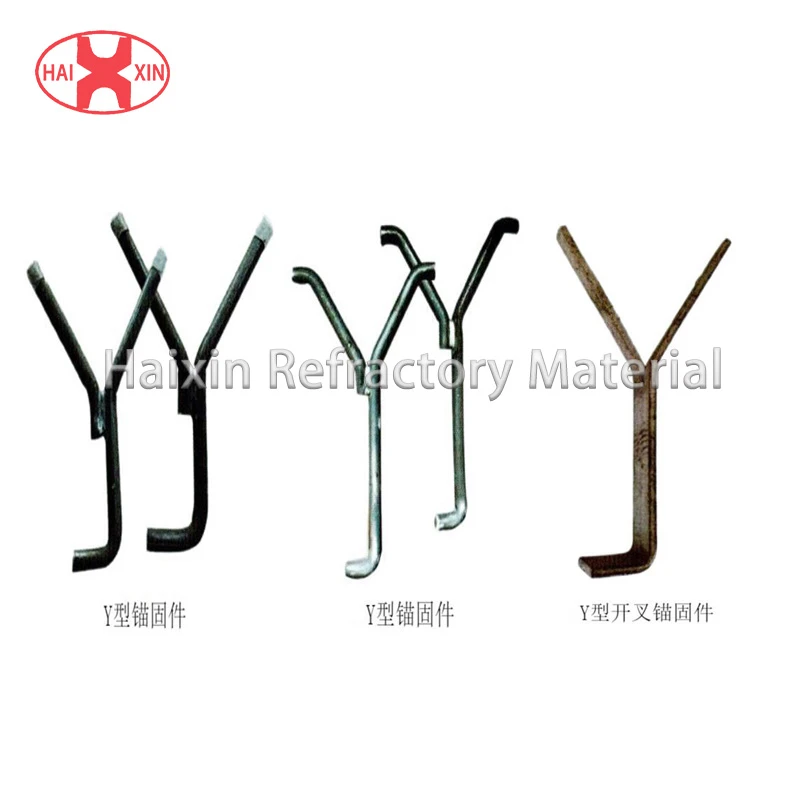
Y-type anchors: Y-type anchors feature a double-forked design, consisting of a head, a shank, and Y-shaped branches. The head is typically welded to the kiln shell, the shank is embedded in the refractory material, and the Y-shaped branches disperse stress through a gripping effect. They are suitable for highly wear-resistant areas, such as cyclone separators, where high-speed material rotation and scouring cause severe wear on the internal lining. Y-type anchors significantly enhance the anchoring effect by increasing the contact area with the refractory material-120% more than straight anchors-making the lining more robust and effectively resisting material scouring and wear. This ensures the efficient separation function of the cyclone separator and makes it widely used in high-wear areas of power plant boilers, cement plants, and other related equipment.
Other shapes: Besides V-shaped and Y-shaped anchors, there are also L-shaped, Z-shaped, and other types. L-shaped anchors have a relatively simple structure; one end is welded to the shell, and the other end is embedded in the lining, connecting the shell and the refractory castable lining into a single unit. They are mainly used to connect the furnace shell and the furnace body steel structure, effectively preventing problems such as kiln wall bulging and collapse. They are commonly used in some small industrial kilns or in areas with specific structural stability requirements. Z-shaped anchors, with their unique Z-shaped structure, have strong shear and tensile strength, and are widely used in applications requiring shear and tensile forces, such as bridges, highways, and tunnels. In the industrial field, such as the connection parts of large industrial equipment, when subjected to complex stresses, Z-shaped anchors can effectively fix and support the relevant structures, ensuring the stability and safety of the equipment.
3.How to select suitable fire-resistant anchors
3.1Select according to operating temperature
Operating temperature is one of the key factors in selecting refractory anchors. When the operating temperature is below 800℃, 304 stainless steel anchors are a more economical and practical choice. In the low-temperature preheating zone of some common industrial kilns, where the temperature is generally between 500℃ and 700℃, 304 stainless steel anchors, with their good corrosion resistance and certain high-temperature resistance, can stably fix the refractory material to the equipment structure, ensuring the normal operation of the kiln within this temperature range, and at a relatively low cost. When the temperature is between 800℃ and 1000℃, 1Cr18Ni19Ti anchors are a good choice. In some medium-temperature superheater areas of power plant boilers, where the temperature is typically between 850℃ and 950℃, 1Cr18Ni19Ti anchors can effectively resist thermal stress, ensuring the safe and stable operation of the boiler in this temperature environment. Their good heat resistance ensures that no deformation or breakage occurs within this temperature range. For high-temperature environments above 1000℃, such as the high-temperature section of steel plant heating furnaces, where the temperature often exceeds 1200℃, 310S stainless steel anchors or ceramic anchors are more suitable. 310S stainless steel possesses excellent high-temperature resistance and oxidation resistance, maintaining stable mechanical properties at high temperatures and firmly securing refractory materials. Ceramic anchors, such as alumina ceramic anchors, offer significant advantages in high-temperature environments above 1200℃ due to their high melting point, good thermal stability, and resistance to chemical corrosion. They can adapt to harsh working conditions such as high temperatures and strong corrosion, ensuring the stability of refractory materials.
3.2Consider the usage environment
The operating environment significantly influences the selection of refractory anchors. In environments with chemical corrosion, such as the high-temperature section of a cement plant rotary kiln, not only are there high temperatures, but also corrosive substances like acidic gases generated during cement production. In such cases, anchors with excellent corrosion resistance, such as Cr25Ni20 heat-resistant steel anchors, should be selected. Containing a high proportion of chromium and nickel, these anchors form a dense oxide film on their surface, effectively resisting the erosion of acidic gases and ensuring long-term stable operation of the anchors in harsh chemical environments, thus guaranteeing the stability of the refractory lining of the rotary kiln. In environments with significant mechanical vibration, such as power plant boilers, which generate a certain degree of mechanical vibration during operation, anchors with strong anchoring force and good vibration resistance are required. Y-type anchors, by increasing the contact area with the refractory material-120% more than straight anchors-effectively enhance the anchoring effect, resisting the effects of mechanical vibration and ensuring the stability of the refractory material under vibration, preventing refractory material detachment due to vibration and ensuring the safe operation of the boiler.
3.3Based on the characteristics of the equipment
The structure and operating conditions of different industrial equipment place specific requirements on the shape and installation method of refractory anchors. In large rotating equipment such as cement rotary kilns, the internal structure is complex and constantly rotating, requiring the refractory material to withstand significant mechanical and thermal stresses. V-shaped anchors, due to their unique V-shaped structure, effectively fix the refractory lining to the furnace steel structure, resisting static loads, thermal stress, mechanical rotation, or vibration, preventing material collapse during construction and heating, ensuring uniform material shrinkage, and avoiding large, concentrated cracks. During installation, V-shaped anchors are typically fixed to the kiln shell by welding, and the spacing of the anchors is rationally arranged according to the diameter and length of the kiln to ensure uniform distribution of the refractory material throughout the kiln, improving the stability of the lining. In smaller industrial kilns with relatively simple structures and lower anchoring force requirements, L-shaped anchors are more suitable. L-shaped anchors have a simple structure, with one end welded to the shell and the other end embedded in the lining, connecting the shell and the refractory castable lining into a whole. They are mainly used to connect the furnace shell and the furnace body steel structure, effectively preventing problems such as kiln wall bulging and collapse. During installation, the length and number of L-shaped anchors can be flexibly adjusted according to the specific size and shape of the kiln. The installation method is also relatively simple, requiring only a simple welding operation.
Refractory anchors, as indispensable key materials in high-temperature industrial equipment, play a crucial role in numerous industries such as cement, power, petrochemicals, and glass. They not only ensure the safe and stable operation of equipment like industrial kilns and extend their service life, but also contribute significantly to improving production efficiency and reducing production costs. With the continuous advancement of high-temperature industries and constant technological innovation, refractory anchors are ushering in even broader development prospects. The research and development of new materials and the design of innovative structures will drive the continuous improvement of refractory anchor performance to meet the demands of higher temperatures and more complex operating conditions.