

Composition of refractory ramming mass
◉ Raw materials and ratio
Refractory ramming material, a granular and powdered material carefully made from refractory raw materials, often contains an appropriate amount of binder, and is loose after reasonable grading and mixing. Its construction method usually requires strong ramming, similar to dry hard castables, but some products do not have self-hardening binders.
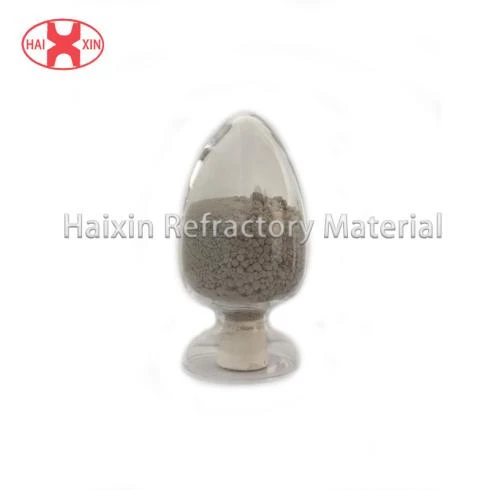
When discussing the composition of ramming materials, we found that granular and powdered materials account for a large proportion, while binders and other ingredients account for a small proportion, and some products are even completely composed of granular and powdered materials. Therefore, it is particularly important to properly grade these granular and powdered materials. These raw materials can come from a variety of materials to meet different usage requirements. Since ramming materials are often used in environments where they are in direct contact with melts, the raw materials must have high volume stability, density and corrosion resistance, and are usually made of high-temperature sintered or molten materials. In addition, in some applications, such as ramming materials in induction circuits, they must also have insulation properties.
Choice of binder
When selecting a binder, it is usually based on the material of the particles and powder and the requirements of use. Some ramming materials may not add a binder, or only add a small amount of flux to promote sintering. For example, in acidic ramming materials, commonly used binders include sodium silicate, ethyl silicate and silica gel. Dry ramming materials often use borates as binders. Alkaline ramming materials often use magnesium chlorides, sulfates, phosphates and their polymers. In addition, some organic substances with high carbon content, such as asphalt and resin, are also used. They can form carbon bonds at high temperatures, thereby enhancing the stability of the material.
Performance and Application
◉ Characteristics
In terms of properties, ramming mass usually does not contain additives such as plasticizers and retarders, and has a low moisture content. When non-water-soluble organic binders are used, the mixture is even free of water. Refractory fibers are also added to some products as reinforcements to further improve the performance of the product.
Compared with the same type of amorphous refractory materials, ramming mass is dry or semi-dry, and its loose characteristics make it non-bonding before forming. Therefore, only through strong ramming can a ramming mass with a dense structure be obtained. The strength in the mixture is usually improved by strong ramming. For those products with temporary binders, the room temperature strength before sintering is relatively low, and the strength will be significantly increased when heated to the sintering temperature. On the other hand, ramming mass made with chemical binders or carbon-containing binders can produce a strong bonding effect after appropriate heat treatment, thereby obtaining high strength.
◉ Construction and use
The fire resistance and resistance to erosion by melt of ramming material can be achieved by carefully selecting high-quality refractory raw materials, reasonable proportioning and strong tamping. Compared with castables and plastics, it shows higher stability and corrosion resistance in high temperature environment. However, its service life is greatly affected by the pre-burning before use or the sintering quality when it is used for the first time. If the heating surface can be sintered into a whole, without cracking and tightly bonded to the bottom layer, its service life will be significantly improved.
Regarding the construction and use of ramming material, it can usually be constructed at room temperature. However, if thermoplastic organic materials are selected as binders, hot mixing and hot ramming construction are required. After molding, different heating methods are required to promote its hardening or sintering according to the hardening characteristics of the mixture. For mixtures containing inorganic chemical binders, the corresponding heat treatment method should be selected according to the hardening characteristics of the binder. For mixtures containing thermoplastic carbon binders, it is necessary to demould after cooling to an appropriate strength and heat quickly before use to promote its coking. In addition, for ramming materials that do not contain binders that harden at room temperature or medium temperature, they are usually sintered with a mold after tamping. For example, siliceous ramming materials can be used to make electric induction furnace linings by adding 1% to 2% boric acid. The mixed materials can be sintered by electric heating after tamping outside the iron core mold. In this way, the lining can be pre-sintered before use, or the sintering process can be completed through a suitable thermal system when it is used for the first time.
◉ Role in the smelting field
Ramming mass plays an important role in the field of smelting. It is often used as a lining material that is in direct contact with molten materials and is widely used in various smelting furnaces. Ramming mass can not only be used to construct the overall lining, but also to manufacture large products. It can even replace refractory bricks to ram specific parts of the metallurgical furnace or the entire furnace. At present, ramming mass is widely used for ramming of part of the lining of the blast furnace, the bottom of the electric furnace, the bottom of the matte smelting reverberatory furnace, and the entire furnace body of the induction furnace. Compared with refractory brick masonry, the rammed furnace body has the significant advantages of no brick joints, strong and dense structure, low risk of metal leakage and strong corrosion resistance, and its service life is significantly longer than that of the brick-built furnace body.