

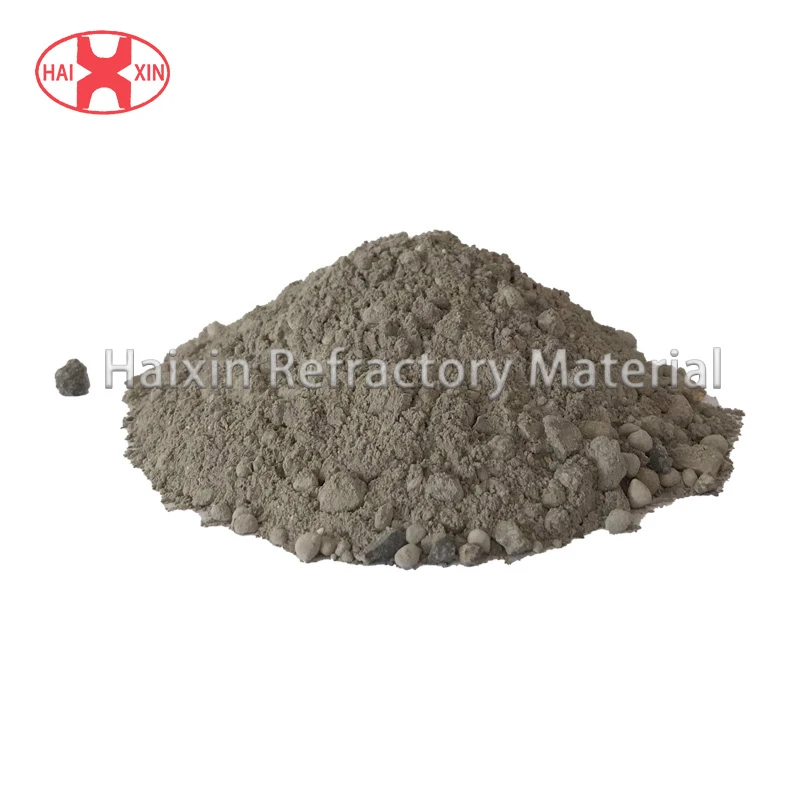
Chrome-zirconium corundum castables are a high-performance refractory material modified by adding chromium oxide (Cr₂O₃) and zirconium oxide (ZrO₂) to high-purity corundum. Its refractoriness can usually reach above 1790℃ and up to 1850℃. The specific value depends on the composition optimization, raw material purity and production process control.
1. Material composition and refractoriness mechanism
Main matrix (corundum): fused white corundum (α-Al₂O₃, purity ≥99%) is used, and its theoretical melting point is as high as 2050℃, providing basic high temperature resistance for the material.
Chromium oxide (Cr₂O₃): added in an amount of 3%~10%, reacting with FeO, CaO, etc. in the slag to form a high melting point spinel phase (such as FeCr₂O₄, melting point>2100℃), forming a dense barrier, delaying slag penetration and indirectly improving refractoriness.
Zirconia (ZrO₂): 5%~15% ZrO₂ is introduced, and its melting point is as high as 2715℃. At the same time, it absorbs thermal stress through the "phase transformation toughening" effect of tetragonal phase → monoclinic phase, reduces the expansion of microcracks caused by thermal shock at high temperature, and maintains structural integrity.
2. Refractoriness range and key influencing factors
Typical range: The refractoriness of conventional formula chromium-zirconium-corundum castable is 1790~1850℃, for example:
The refractoriness of the basic formula (Cr₂O₃ 5%, ZrO₂ 8%, corundum 80%) is about 1800~1820℃;
The refractoriness of the high-purity formula (Cr₂O₃ 3%, ZrO₂ 5%, corundum 90%) can exceed 1850℃.
3. High temperature performance in actual application
Service temperature: It can withstand high temperature environment of 1600~1750℃ for a long time in metallurgical furnaces (such as ladle, RH refining furnace);
Corrosion resistance: The spinel layer formed by the reaction of Cr₂O₃ and alkaline slag can resist the erosion of high alkalinity (CaO/SiO₂>2) slag, and the erosion rate is 30%~50% lower than that of ordinary corundum castables;
Thermal shock stability: The phase change toughening of ZrO₂ enables the material to withstand more than 20 times in 1100℃ water cooling cycle, avoiding structural peeling caused by rapid cooling and heating, and indirectly extending the high temperature service life.
The chromium-zirconium corundum castable achieves a balance between refractoriness, slag resistance and thermal shock stability through the high melting point characteristics of the corundum matrix and the functional synergy of Cr₂O₃/ZrO₂, making it an ideal choice for high-temperature equipment in steel metallurgy, petrochemical and environmental protection.