

I.What are high alumina Poly Light bricks?
High alumina poly light bricks are a type of lightweight, heat-insulating, and refractory material made primarily from high-alumina bauxite clinker, with the addition of a high-quality, combustible foaming agent, through batching, molding, and high-temperature sintering. They retain the high-temperature resistance of high-alumina materials while achieving a balance between lightweighting and thermal insulation through pore design. Compared to traditional heavy high-alumina bricks, their bulk density is only 1.0-1.6 g/cm³ (compared to approximately 2.6 g/cm³ for traditional products), making them a key material for achieving weight reduction and efficiency improvement in high-temperature industrial applications.
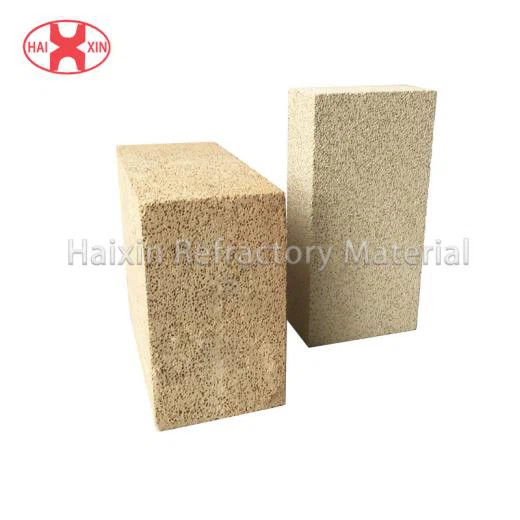
II. Why are high alumina Poly light bricks the preferred choice for high-temperature applications?
Excellent thermal insulation performance:
With a closed microporosity of 40%-60% and a low thermal conductivity (only 0.3-0.6 W/(m・K) at 800℃), it can effectively block heat conduction and reduce heat loss in industrial kilns, saving 15%-30% energy compared to ordinary refractory bricks.
Balancing high strength and high temperature resistance:
With an Al₂O₃ content of ≥65%, a refractoriness of over 1790℃, a room temperature compressive strength of ≥15MPa, and a low high-temperature creep rate, it can stably serve in long-term high-temperature environments of 1200-1400℃, solving the pain point of traditional lightweight bricks that are "heat-insulating but not load-bearing".
Low heat storage and strong thermal shock resistance:
The lightweight design reduces the heat storage of the material itself, allowing the kiln to heat up and cool down faster, further reducing energy consumption; at the same time, the microporous structure can buffer the thermal stress generated by sudden temperature changes, and the thermal shock resistance (water cooling at 1100℃) can reach more than 15 cycles, extending the service life of the kiln.
Environmentally friendly and easy to construct:
No harmful gases are emitted during the production process, and the bricks can be recycled and reused after disposal. The product has a low density, and the weight of a single brick is only 1/3 to 1/2 of that of traditional high alumina bricks, which reduces the labor intensity of construction and increases the efficiency of masonry by more than 40%.
III. In which fields can high alumina Poly light bricks be applied?
High alumina poly light bricks, with their combined advantages of high temperature resistance, lightweight, and thermal insulation, are widely used in the following fields:
Building materials industry:
Preheaters for cement rotary kilns, decomposition furnaces, tertiary air ducts for cement kilns, insulation layers for glass kilns, and linings for annealing kilns can reduce heat dissipation from the kiln body and improve energy utilization.
Metallurgical industry:
Insulation layers for hot blast stoves, linings for soaking furnaces, insulation layers for steel ladles, flues for non-ferrous metal smelting furnaces, waste heat boilers, etc., reduce heat loss and lower production costs.
Chemical industry:
Insulation layers for gasiLinings and insulation layers for high-temperature equipment such as waste incinerators, industrial boilers, and ceramic kilns are particularly suitable for scenarios with strict requirements on equipment weight and heat dissipation efficiency.er plants, linings for chemical reactors, and insulation for high-temperature pipelines, suitable for corrosive, high-temperature, and high-pressure complex working conditions.
Other fields:
Linings and insulation layers for high-temperature equipment such as waste incinerators, industrial boilers, and ceramic kilns are particularly suitable for scenarios with strict requirements on equipment weight and heat dissipation efficiency.
IV. How to maintain high-alumina lightweight spherical bricks in practical applications?
The core principles of using and maintaining high alumina poly light bricks are: temperature control and corrosion prevention, regular inspections, and timely repairs.
Comprehensive maintenance is required, taking into account its lightweight insulation and high-temperature service characteristics: During furnace baking and shutdown, follow the principle of segmented heating and natural cooling to avoid thermal stress caused by rapid temperature changes; during operation, do not exceed the operating temperature and reserve a safety margin; take protective measures for different working conditions; regularly check and reapply protective layers in strongly alkaline or corrosive environments to prevent bricks from directly contacting molten materials and high-temperature materials, while ensuring equipment sealing to reduce gas erosion and media accumulation; regularly clean the furnace chamber of accumulated ash and residue, and do not use strong acid or alkali cleaning agents; inspect the bricks for defects such as cracks and peeling every 3-6 months, and fill the brick joints with matching refractory mortar in time; monitor the temperature of the outer wall of the equipment to judge the degradation of insulation performance; treat minor defects with special refractory repair agent, and replace the larger damage with the same specification product locally; thoroughly clean and take moisture-proof measures when the furnace is shut down for a long time; if there is large-area damage, or a significant decrease in strength or insulation effect, the whole equipment must be replaced to ensure safe operation.