


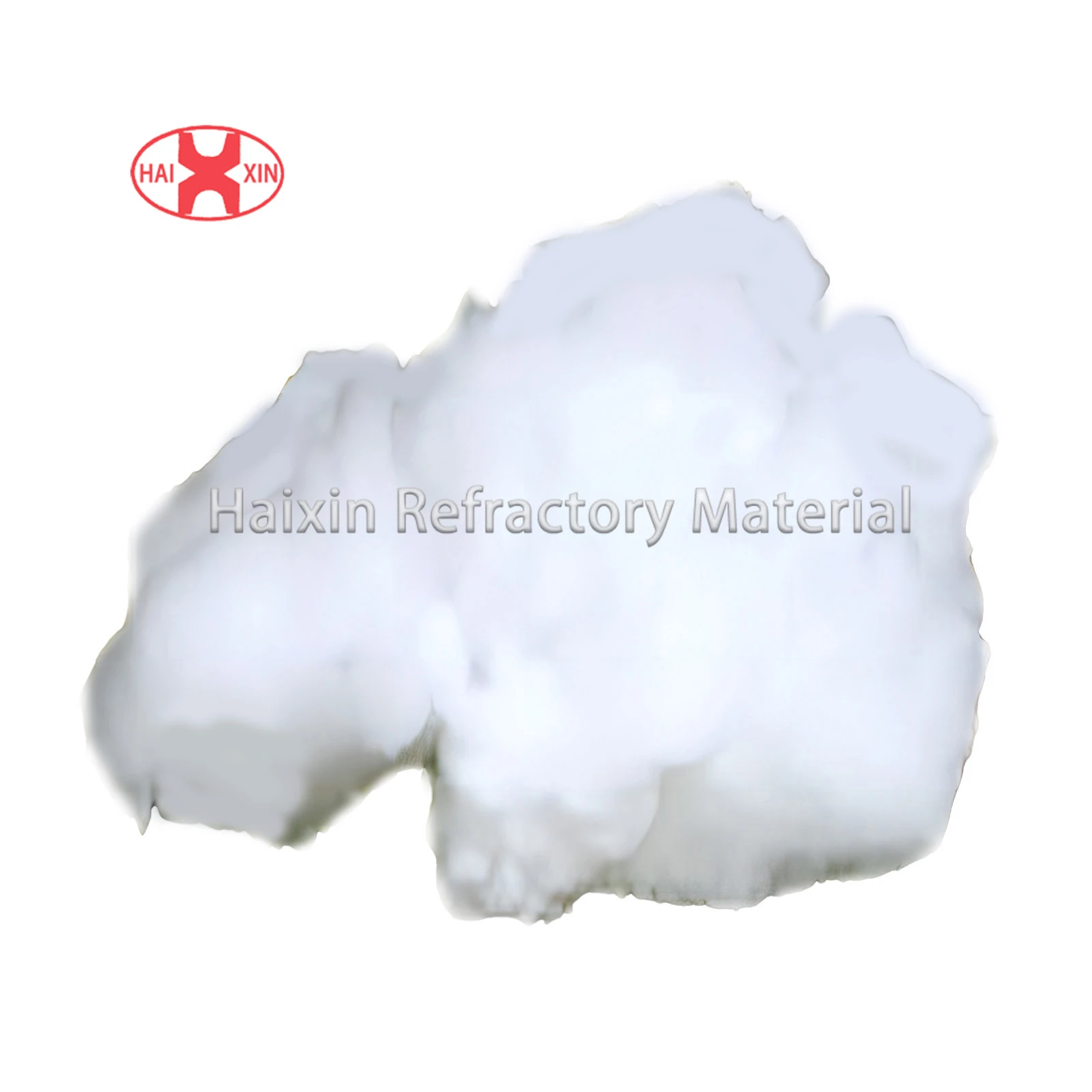
The manufacturing process of polycrystalline mullite refractory fiber is different in chemical composition from A95 and A80. It is chemically proportioned according to the formed single crystal mullite (3Al203·2SiO2, 3A2S), and strives to minimize energy consumption, best environmental conditions, and various performance indicators, especially the minimum shrinkage rate at high temperature, during the production process.
Advantages of polycrystalline mullite refractory fiber production
Crystal fiber products can be divided into A72, A80 and A95 according to the different Al2O3 content. The selection of which content to put into production needs to be determined by analyzing various factors and conditions:
1.The main crystal phase of A95 is α-Al2O3 and a small amount of mullite and θ-Al2O3, the main crystal phase of A80 is mullite and a small amount of θ-Al2O3, and the main crystal phase of A72 is single mullite. The calcination temperature and crystallization of the three fibers are different. A72 has a low calcination temperature and only has a single phase of mullite. A95 and A80 have high calcination temperatures and contain two-phase grains. In long-term use, the growth rates of mullite and α-Al2O3 are different, and the growth rate of α-Al2O3 is significantly greater than that of mullite.
2.The true specific gravity of α-Al2O3 is 3.4, and the true specific gravity of mullite is 3.0. If two fibers with the same diameter are made from these two materials, the latter is about 12% more than the former at the same weight. Products made from these two fibers have different bulk densities, porosities and thermal conductivity at the same volume.
3.If aluminum powder is used as raw material, the amount of A95 fiber used is 19.2% more than that of A72, and the cost and energy consumption of the product will also increase accordingly.
Production process of polycrystalline mullite fiber
The production of polycrystalline mullite fiber also adopts the colloid method, and its chemical composition is Al2O372-75%, SiO225-28%. Its manufacturing principle is to make soluble aluminum and silicon salt into a colloidal solution with a certain viscosity, and then make the solution into filaments by general conventional methods, and then transform it into Al-Si oxide polycrystalline fiber through heat treatment.
Preparation of Colloid
The colloid process is essentially to convert aluminum salts and aluminum containing aluminum into corresponding oxides according to the type of crystals, and then add other materials to make a colloidal sol with high viscosity and fiber-forming ability. According to this principle, industrial-grade crystalline aluminum chloride can be selected to prepare an aqueous solution, and metallic aluminum is dissolved in the solution according to a certain ratio of A1 and C1. The solution undergoes violent chemical reactions such as hydrolysis and polymerization to form a transparent and stable aluminum oxychloride inorganic colloid-mother liquor. Since the raw material used, aluminum chloride aqueous solution, is highly corrosive, metal cannot be used in the entire set of equipment. In particular, the material of the container that heats the aluminum chloride aqueous solution to boiling is critical.
According to the chemical composition of the mullite crystal phase, it is necessary to add a glue solution prepared with silica gel to the mother liquor. When preparing the glue, in order to avoid the occurrence of colloidal gel and precipitation, and also to inhibit the enrichment of SiO2 after the fiber is calcined to form a crystal phase, thereby producing cristobalite and excessive grain growth, some organic acids can be appropriately added. The prepared colloid will be heated and concentrated, and a part of the solvent (mainly physical water) will be removed to make the viscosity of the colloid polymerization reach the required index. In order to facilitate the control of the rheological properties of the colloid, a certain amount of high molecular polymer should be added to the glue solution. Due to the large amount of colloidal solution concentration process, long time, strict temperature control, high uniformity requirements, and precise viscosity control requirements, a series of measures should be taken to increase the evaporation area and improve the liquid surface environment, and a suitable concentration system should be selected.
Fiberization
Fiberization is the key to the production of polycrystalline mullite fiber, and it is also a difficult link. In order to improve the quality of the fiber and reduce slag balls and inclusions, the normal temperature high-speed centrifugal spinning and blowing fiberization method can be adopted. That is, firstly put the prepared colloid in a pressure vessel, and send the colloid to the high-speed rotating disc through air pressure. After the colloid is centrifugally thrown out, it is blown into fiber by hot air. In this process link, the four links of colloid viscosity, disc speed, hot air flow temperature and fiberization tower temperature have a certain internal relationship, and none of them can be missing.
Fiber drying, heat treatment and calcination
The fiber embryo obtained by the fiber forming process has a large surface area and is very easy to absorb moisture in the air and become foamy. Therefore, it must be dried quickly, otherwise the fibers will be bonded, making the product brittle and powdery. The fiber embryo must be heat treated immediately after drying for a certain period of time to dehydrate the fiber at high temperature, burn off the organic compounds, and convert the chloride ions (C1-1) in the aluminum salt into corresponding chlorinated gas to escape. In this process, the heating rate must be strictly controlled to ensure that the fiber structure is not destroyed. Under this condition, the heating rate of heat treatment can be increased as the fiber diameter decreases. During the heat treatment process, corrosive gases with a certain temperature (higher than 500°C) will be generated, which requires careful selection of furnace design materials.
After the fiber embryo has gone through the two processes of drying and heat treatment, the glass fiber that becomes is generally called a semi-finished product. At this time, the fibers will not stick to each other. The semi-finished product is then put into a furnace for high-temperature calcination and is heated according to a certain temperature rise curve to finally become polycrystalline mullite fiber.
Product Description
Polycrystalline mullite fiber wool (PMF) is a new type of ultra-light high-temperature refractory fiber wool. It is one of the entire Al2O3-SiO2 ceramic fibers. The use temperature is 1500-1700℃, which is 200-400℃ higher than glass fiber. It can be widely used in the lining insulation of high-temperature industrial kilns and other thermal equipment such as metallurgy, machinery, electronics, ceramics, chemicals, glass, aerospace, military scientific research, etc. The product can directly contact the flame, is resistant to erosion, has low thermal conductivity, can effectively extend the life of the kiln, and improve production efficiency.
Product Features
■ Low thermal conductivity;
■ Low heat capacity;
■ Excellent thermal shock resistance;
■ Excellent chemical stability;
■ Does not contain any binder or other corrosive substances;
■ Still loose and flexible with good elasticity at high temperatures.
Applications
■ Insulation of various high-temperature industrial furnaces;
■ Raw materials for making other polycrystalline mullite insulation materials such as boards, paper, and vacuum-formed parts.
Product Parameters
|
model |
HX-PMF1600 |
HX-PMF1700 |
|
|
Classification temperature (℃) |
1600℃ |
1700℃ |
|
|
Structural form |
Crystal Fiber |
Crystal Fiber |
|
|
Fiber diameter (μm) |
3.2 |
3 |
|
|
chemical components (%) |
Al2O3 |
72 |
95 |
|
Al2O3+SiO2 |
99 |
99 |
|
|
Fe2O3 |
<0.1 |
<0.1 |
|
|
Specification and packaging: 5-20Kg/bag, woven bag packaging. |
|||
Hot Tags: polycrystalline mullite wool, China polycrystalline mullite wool manufacturers, suppliers, factory, Polycrystalline Mullite Wool, Polycrystalline Mullite Fiberboard