

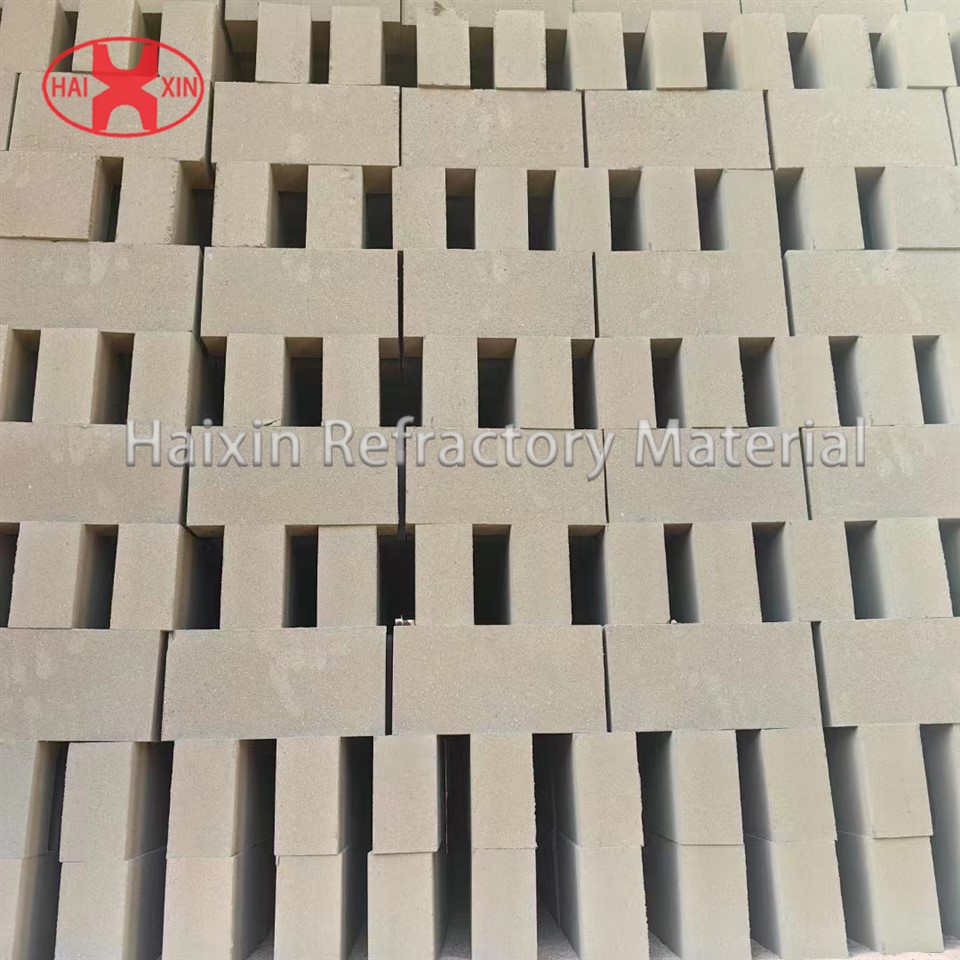

High-strength high-alumina insulating refractory bricks are made of bauxite as the main raw material, with an AlO content of not less than 48%. High-strength high-alumina insulating refractory bricks mainly use bauxite clinker, combined with clay as raw materials, mixed with binders and sawdust. In order to improve product performance, fine powders of industrial alumina, corundum, sillimanite, kyanite, and silica are added to produce products with a volume density of more than 0.4g/cm*. The maximum operating temperature is different for different AlO content and volume density, usually between 1250~1350℃, and some can reach 1550℃.
The process of high-strength high-alumina insulating refractory bricks includes five parts: preparation of foaming agent, modulation of foam mud, molding, drying and firing.

Products Description
1.Preparation of foaming agent for high-strength and high-alumina thermal insulation refractory bricks. Foaming agent is essentially a surfactant. Foam is a dispersion system of air in a liquid phase. In this system, air is the dispersed phase and liquid is the dispersion medium for bubble separation. At the gas-liquid interface, an adsorption layer is formed. The greater the surface activity, the stronger the adsorption layer formed, and the stronger the ability to adsorb solid fine particles. The stability of the adsorption layer is related to the concentration of the foaming agent. The pH value of the colloidal solution generated by gas and liquid also affects the stability. The pH value of the foaming agent used in the factory is between 8 and 9. When the arrangement of the surfactant molecules in the surface layer is unsaturated, the foam is most stable. At this time, the foaming agent can be fully hydrated and firmly combined with water. The quality of the foaming agent is generally identified by three performance indicators: foam toughness, water exudation, and foaming multiple. Rosin soap is commonly used as a foaming agent. Its preparation method is: put a mixture of rosin (31%), NaOH (6.1%), and water (62.%) into an alkali-resistant heater and heat it to 70~90℃ until the rosin is completely dissolved and saponified. After cooling, wash with salt water 3-4 times on a 0.147mm net, and then rinse with clean water 1-2 times, so that the pH value reaches 8-9 to obtain a light yellow paste of rosin soap. Add rosin soap to hot glue water and stir evenly to form a rosin soap foamer. Alum or aluminum sulfate is often used as a foam stabilizer. The water glue solution is mixed with the emulsion of rosin soap in a hot state, and the mixture is diluted with water to a liquid with a rosin content of 10%, and then stored in this state. The foamer entering production also needs to be diluted with water to a density of 1.0-1.10g/cm3. When it contains 0.5% rosin (calculated as rosin), 0.5% water glue (calculated as the thousand weight of water glue) and 99% water, it is put into a foaming machine and foamed to produce small and uniform white foam with a volume density of 0.04-0.05g/cm3.
2.Preparation of foamed mud for high-strength and high-alumina heat-insulating refractory bricks. Finely crushed bonding clay, high-alumina clinker and screened sawdust are mixed with water in proportion to make mud. Then, they are mixed with the prepared foam in a mixer in proportion to make foamed mud. The ratio of foam to mud depends on the volume density of the product. Foamed mud with a volume density of 0.51~1.26g/cm* can be made into high-strength and high-alumina heat-insulating refractory bricks with a volume density of 0.4~1.0g/cm3.
3.High-strength and high-aluminum insulating refractory brick molding. The brick mold can be a wooden mold or a metal mold. The working surface of the brick mold should be smooth and lubricated. The brick mold is placed on a dry board with pad paper and foam mud is injected. In order to prevent the product from generating large bubbles and affecting the organizational structure, the grouting should be carried out slowly and the mud should be stirred or vibrated in the mold to exhaust air, and then the remaining slurry should be scraped off with a wooden board.
4.Drying of high-strength and high-alumina insulating refractory bricks. After pouring, dry the mold at about 40°C for 18 to 20 hours. When a gap of 3 to 5 mm is opened around the brick mold, demould it and continue drying. At this time, the temperature can be raised to 80 to 90°C; if dried in a tunnel dryer, the inlet temperature should not exceed 40°C and the outlet temperature should not exceed 150°C. Residual moisture in the brick blank: no more than 3% for standard bricks and no more than 1% for large bricks. Drying is a key process. If it is not properly controlled, cracks, bottom crispness, concave core, sticky mold, and falling edges and corners will appear.
5.Firing of high-strength and high-alumina insulating refractory bricks. Use side loading kiln, build a frame with silica bricks, and stack the bricks in the frame. The height of the stacking frame should not exceed 1.6m. Determine the kiln loading position and the fire stopping temperature according to the volume density of the product and the content of ALO. The fire stopping temperature is usually 1320~1380℃, and the insulation time is 5~8h. The higher the content of ALO, the higher the fire stopping temperature of the product, even up to 1580~1620℃. Due to casting and molding, the shape of the fired product is irregular and needs to be ground and shaped to meet the requirements.
Applications High-strength and high-aluminum insulating refractory bricks can be used to build thermal insulation layers and areas that are not subject to strong erosion and erosion by high-temperature molten materials. When in direct contact with flames, the surface contact temperature of general high-aluminum insulating refractory bricks shall not be higher than 1350°C. High-strength and high-aluminum insulating refractory bricks can directly contact flames and have the characteristics of high temperature resistance, high strength and significant energy-saving effect. High-strength and high-aluminum insulating refractory bricks are suitable for linings of pyrolysis furnaces, hot blast furnaces, ceramic roller kilns, electric porcelain drawer kilns and various resistance furnaces.
|
Brand |
HXG-1.3 |
HXG-1.2 |
HXG-1.0 |
HXG-0.9 |
HXG-0.8 |
HXG-0.7 |
HXG-0.6 |
HXG-0.5 |
|||||||
|
Bulk density g/cm3 ≤ |
1.3 |
1.2 |
1.0 |
0.9 |
0.8 |
0.7 |
0.6 |
0.5 |
|||||||
|
Normal temperature compressive strength Mpa ≥ |
9.0 |
8.0 |
6.5 |
5.0 |
4.0 |
3.0 |
2.5 |
2.0 |
|||||||
|
Re-firing line changes ≤ 2%(℃×h) |
1400×12 |
1400×12 |
1400×12 |
1400×12 |
1400×12 |
1350×12 |
1350×12 |
1250×12 |
|||||||
|
Thermal Conductivity W/m. k (350±25℃) ≤ |
0.47 |
0.41 |
0.35 |
0.30 |
0.26 |
0.2 |
0.17 |
0.15 |
|||||||
|
Fe2O3 % |
≤1.5 |
||||||||||||||
|
Al2O3 % |
≥52 |
||||||||||||||
Hot Tags: high strength and high alumina insulating refractory bricks, China high strength and high alumina insulating refractory bricks manufacturers, suppliers, factory, insulation bricks, Mullite Lightweight Brick, Lightweight Mullite Poly Light Insulation Brick