

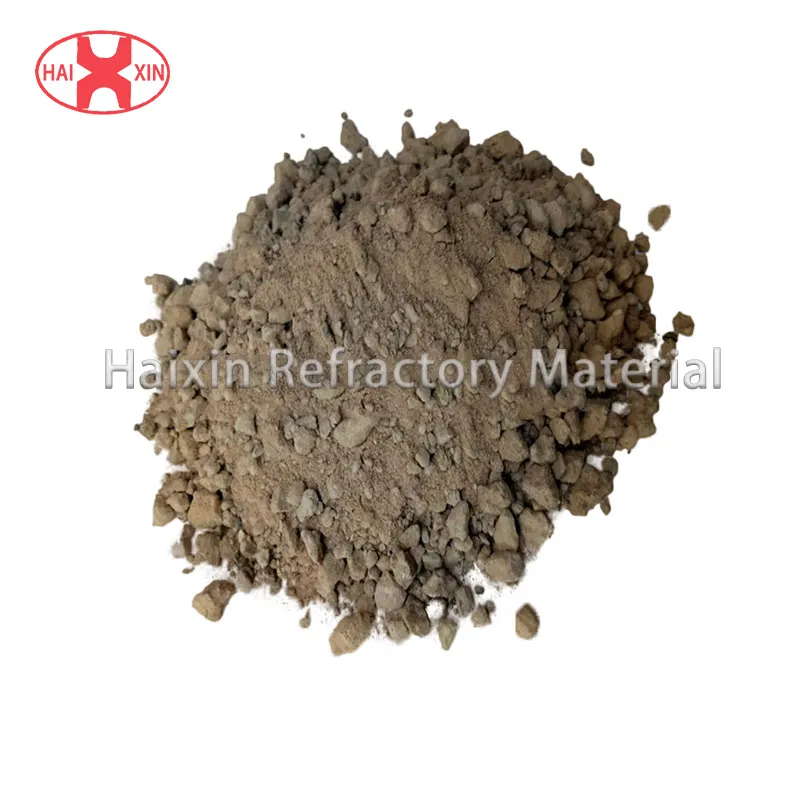
Ramming matriat for electric furnace bottom/Gunning mix for slag line
The amorphous refractory material used to repair the lining of thermal equipment by spraying construction method. It is composed of refractory aggregates with a certain particle size distribution, binders and additives (including accelerators, plasticizers, sintering aids and mineralizers, etc.), which are generally heat-hardening or gas-hardening materials. Spraying repair is usually a repair method used when the furnace lining is partially damaged prematurely but most of it is still intact. It can make the furnace lining reach balanced or nearly balanced damage. Its characteristics are simple construction, short construction period, no templates and brackets are required for construction, and it can effectively extend the life of the furnace lining and reduce the consumption of refractory materials.
Classification According to the main material of the gunning material, it can be divided into magnesium oxide, magnesium calcium, magnesium chromium, magnesium carbon, aluminum silicate and aluminum oxide-silicon carbide-carbon gunning material, etc.; according to the construction method, it can be divided into wet method (mud method) gunning material, semi-dry method (nozzle mixing) gunning material and flame method (melt spraying method) gunning material. According to the use conditions, it can be divided into converter gunning material, electric furnace gunning material, steel ladle gunning material, vacuum degassing device (RH, DH) gunning material, iron ditch gunning material and blast furnace lining gunning material.
Products Description
The composition, performance and use effect of the refractory gunning material used are different due to different construction methods.
Wet gunning is a method of mixing refractory aggregate, binder, additive and water to form a slurry of a certain consistency, and then spraying the slurry onto the gunning surface with compressed air through a gunning machine. It is characterized by simple operation, high adhesion rate and rapid sintering, but due to the high water content and fine particles, the shrinkage is also large. At the same time, due to the thin gunning layer, the durability is not very good.
Semi-dry gunning is a method in which a mixture of refractory aggregate, binder and additive is mixed with water through the water ring hole at the tail end of the spray gun and sprayed onto the gunning surface by compressed air. The amount of water can be adjusted at any time according to the gunning situation, generally fluctuating between 10% and 20%, which is much lower than the water consumption of wet gunning. Therefore, the gunning layer has a large volume density and small shrinkage, and a thicker gunning layer can be obtained with better durability, but the rebound is slightly higher than the wet method. This gunning method is widely used.
Flame gunning is a repair method that uses compressed oxygen to transport a mixture of refractory aggregate, flux or heating agent to the nozzle, mixes it with a high calorific value fuel and burns it, and then heats the refractory aggregate to a molten or semi-molten state, and then sprays it onto the lining. The gunning layer obtained by this construction method has a dense structure, high strength, strong erosion resistance, strong anti-scouring ability, and is solid and durable. However, the flame gunning technology is complex, and the equipment cost and energy consumption are high.
Material selection The key to the preparation of refractory gunning materials is to reasonably select the main material, select the appropriate binder, additives, etc., and determine the best particle size composition. The selection of the main material is based on the highest temperature that can be reached in the kiln, the temperature fluctuation range, the properties of the slag, and the material of the lining itself. Commonly used raw materials include magnesia, dolomite, magnesium chromium, aluminum silicate, zircon and silicon carbide. The binders used are silicates, phosphates, polyphosphates, phosphate complexes, sulfates, chlorides, asphalt, resins and cement. In order to give the refractory gunning materials good construction properties (such as transportation, wetting, plasticization, adhesion and sintering properties), a variety of additives must be added, such as impregnants, accelerators, plasticizers, sintering aids, etc. Commonly used plasticizers are clay and methyl cellulose. Sintering aids include iron oxide, serpentine, olivine, borax, etc. The particle size composition and limit particle size of the gunning material should be determined according to the structure of the gunning machine, the thickness of the gunning layer and the gunning method. Generally speaking, too coarse particles or too many coarse particles will lead to a decrease in adhesion rate. Semi-dry gunning materials have more coarse particles than wet gunning materials, and the critical particle size is also larger, sometimes up to 3-7mm, or even larger.
Spraying operation has an important influence on the quality and rebound of the sprayed material. The distance from the nozzle to the sprayed surface is generally 0.8-1m. Usually the nozzle should be perpendicular to the sprayed surface and move in a spiral trajectory. The spraying wind pressure is generally 0.1-0.6MPa. The thickness of one spraying is based on the sprayed material not slipping or falling. However, each spraying layer should not be too thin to avoid increasing the rebound rate. Take aluminate cement refractory spraying material as an example: 20-50mm when spraying upward; 30-60mm when spraying horizontally; 50-100mm when spraying downward.
Rebound rate is the ratio of the amount of material lost by rebound (not adhered) to the total amount of material sprayed. The rebound rate varies according to factors such as the spraying position, air supply pressure, cement dosage, maximum aggregate particle size and gradation, the number of steel bars set on the sprayed surface and the thickness of the sprayed layer. Among them, due to the change of rebound rate in different spraying positions, at the same time, the rebound rate is relatively large at the beginning of spraying. When the sprayed material has been attached to form a plastic layer, the coarse aggregate is easy to embed, and the rebound rate gradually decreases. The thickness of one spraying should not be less than 20mm. The relationship between the thickness of one spraying and the average rebound rate is shown in the figure. The cement content in the rebound material is very small, mainly coarse aggregate, so the rebound material cannot be used again.
1.)Ramming material:It is manufactured by using High quality synthetic MgO-CaO-Fe2O3 sand as raw materials,and determing reasonably granular composition.The product has good sintering property,strong corrosion resistance,convenient construction,strong integrity,which can be also used for the first time,hot repair,and suitable for high power electric furnace,ultra high power electric furnace bottom,furnace slope and other parts.
2.)Gunning mix for Slag line:It is manufactured by using high quality dead burned magnesia and other basic composite materials,through good grain size selection.The product has good sintering and slag erosion resistance,the construction of the rebound rate is small,high adhesion rate,easy for spray repair operation.It is suitable for hot spot,slag line,furnace slope,side wall and steel outlet of electric furnace and ultra-high power electric furnace.It is helpful to improve the evenness of furnace lining erosion and is an ideal material for improving the service life.
|
Brand Item |
HX-MCF-7 |
HX-MCF-12 |
HX-PBL-A |
HX-PBL-B |
|
|
Mg0 % |
≥80 |
≥75 |
85 |
80 |
|
|
Ca0 % |
7-9 |
12-14 |
- |
- |
|
|
Fe2O3 % |
5-7 |
5-7 |
- |
- |
|
|
SiO2 % |
≤ 1.2 |
≤ 1.2 |
≤ 4 |
≤ 6 |
|
|
Modulus Of Rupture Mpa |
100℃×24h |
- |
- |
≤ 0.5 |
≥ 0.5 |
|
1500℃×3h |
- |
- |
≥ 6 |
≥ 6 |
|
|
Linear change rate % |
1500℃×3h |
- |
- |
-0.9 |
-0.1 |
|
Granularity (mm)Size |
0-5 |
0-6 |
0-3 |
0-4 |
|
Hot Tags: electric furnace slag line gunning material, China electric furnace slag line gunning material manufacturers, suppliers, factory, Ladle Edge Refractory Castable, Converter Repair Bricks and Taphole Repair Materials, Electric Furnace Bottom Ramming Material, Converter Large Surface Filling Material